
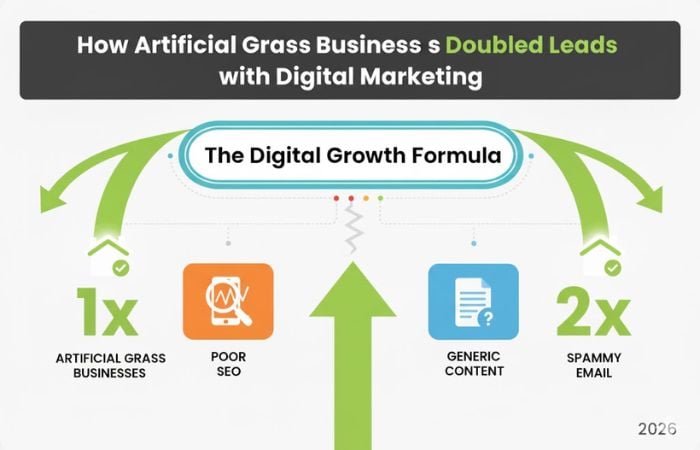
For artificial grass businesses, embracing AI-powered digital marketing means transforming unpredictable seasonal demand into a consistent flow of high-quality leads. By automating engagement, qualification, and follow-up, you can achieve remarkable growth. This article dives deep into what AI-driven marketing truly offers turf installers, revealing its power (think real-time engagement and predictive scoring) and the tangible results: significantly higher qualified-lead rates, dramatically faster time-to-contact, and crystal-clear marketing ROI. You’ll discover the primary lead-generation hurdles synthetic turf companies face, how specific AI tools—like chatbots, voice assistants, and predictive lead scoring—conquer these challenges, and which digital channels and automated workflows deliver reliable, scalable growth. We’ll outline practical strategies across SEO, PPC, social media, email/SMS, reputation management, operational integration, and the key performance indicators (KPIs) essential for proving impact. Plus, we provide a clear implementation roadmap and show you exactly where to find productized AI examples and request a personalized demo. Let’s start by uncovering the common market challenges that currently hinder scalable lead generation for artificial grass companies.
The Core Lead Generation Challenges Facing Artificial Grass Businesses
Artificial grass companies often grapple with fluctuating demand, significant purchase decisions, and intense local competition. These factors combine to create unpredictable lead pipelines and inconsistent conversion rates. Seasonality compresses search activity into brief peak periods, yet many potential customers spend weeks researching, demanding consistent, context-aware engagement throughout their journey. The double whammy of low-quality, untargeted leads and sluggish manual follow-up drastically slashes close rates, diverting valuable installer time away from high-value proposals. Grasping these fundamental challenges makes it clear why automation and predictive prioritization are absolutely essential for plugging lead leaks and boosting your marketing ROI. Below, we’ve summarized the key obstacles installers face, setting the stage for the powerful solutions we’ll explore.
- Seasonal Demand Swings: Search volumes surge in spring and early summer, creating tight conversion windows you can’t afford to miss.
- Overwhelmed by Low-Quality Leads: A flood of inquiries often consists of product comparisons, not ready-to-buy requests.
- Lagging Manual Follow-Up: First contact often takes hours or even days, drastically reducing your conversion potential.
- Limited Local SEO & Visibility: Subpar service-area pages and inconsistent online citations mean fewer local customers find you.
The Limitations: Why Traditional Marketing Falls Short for Turf Installers
Traditional marketing tactics—think print ads, broad paid campaigns, and manual referral management—are inherently constrained by rigid timing, murky attribution, and a complete absence of real-time qualification. Offline channels and static PPC campaigns might generate volume, but they utterly fail to differentiate between genuinely high-intent buyers and casual browsers. This leaves your sales teams sifting through leads manually, with wildly inconsistent outcomes. Without seamless, automated data flowing directly into your CRM, attribution remains a mystery, making it incredibly risky to scale paid advertising when you can’t pinpoint which channels actually deliver qualified leads.
Consider this common scenario: a homeowner submits a generic estimate request. If your response arrives a day later, their interest has likely evaporated, and your conversion probability plummets. Acknowledging these operational bottlenecks immediately highlights the critical need for automation that captures intent and scores leads the moment they arrive.
The Real Cost: How Unqualified Leads and Manual Processes Stifle Your Growth
Unqualified leads don’t just inflate your cost-per-lead; they cripple your cost-per-sale efficiency. Your sales team wastes precious time chasing low-probability prospects instead of closing lucrative, high-value jobs. Let’s look at a clear example: if your company gets 200 leads a month at a $50 CPL but only 10% are truly qualified, your *effective* cost-per-qualified-lead skyrockets, severely eroding your margins. Furthermore, manual processes—like data entry, scheduling, and follow-up texts—create frustrating bottlenecks that extend time-to-contact and dramatically increase lead abandonment. This operational drag also severely restricts your ability to scale advertising spend, as fulfillment, not demand, becomes your limiting factor. Clearly quantifying these losses highlights the urgent need for automated capture, qualification, and intelligent routing that directs your efforts precisely to leads with the highest conversion potential.
Unleashing Growth: How AI Marketing Revolutionizes Lead Generation for Artificial Grass Companies
AI marketing isn’t just an upgrade; it’s a complete revolution for turf lead generation. It empowers immediate, context-aware engagement and intelligent, automated prioritization, transforming casual interest into concrete, scheduled consultations. At its heart, AI chatbots and voice assistants interact with prospects in real time, gathering crucial qualifying signals and feeding that data directly into predictive lead scoring models. These models then rank leads by their likelihood to purchase. Automated follow-ups—delivered seamlessly via SMS, email, or even outbound voice—keep momentum strong throughout the buyer’s seasonal research phase, drastically cutting down your time-to-contact. This powerful combination dramatically boosts your qualified-lead rate and shortens sales cycles, delivering a measurable surge in your conversion metrics and overall marketing ROI.
| AI Tool | Core Function | Time to Engage Lead | Qualification Accuracy |
|---|---|---|---|
| AI Chatbot | Real-time website engagement and data collection | Seconds to minutes | Medium–High (contextual questioning) |
| Voice Assistant | Captures inbound phone interest and converts to CRM entry | Minutes | High (verbal intent detection) |
| Predictive Lead Scoring | Ranks leads using behavior and profile signals | Instant scoring on capture | High (models prioritize likely buyers) |
This table clearly illustrates how strategically combining chat, voice, and predictive scoring dramatically amplifies the effective throughput of your incoming traffic and significantly reduces wasted sales team effort.
Next, we’ll dive into the specific AI tools that make this possible and explore exactly how they function within the unique world of turf installation.
Essential AI Tools for Supercharging Lead Qualification and Customer Engagement
The AI tools that truly elevate lead qualification include intelligent conversational chatbots, sophisticated automated voice assistants, dynamic lead capture forms powered by conditional logic, and seamlessly CRM-integrated scoring engines that update in real time. Chatbots slash response times by instantly engaging website visitors, asking precise questions about project scope, budget, and timeline, all while effortlessly capturing vital contact details. Voice assistants expertly transcribe and analyze verbal intent from phone calls, transforming conversations into structured CRM records and triggering immediate follow-up actions. Meanwhile, predictive scoring models meticulously evaluate behavioral signals (like page views, form responses, and call duration) alongside firmographic data (such as service area and property type) to assign clear priority flags to your leads. Collectively, these powerful tools guarantee that your sales teams are always focused on the most promising opportunities, ensuring no high-intent prospect ever slips through the cracks.
The tangible operational benefits of these tools—quicker contact, superior qualification, and significantly higher appointment show rates—naturally lead us to explore the mechanics of predictive lead scoring and how to set optimal thresholds specifically for turf businesses.
Supercharge Your Sales: How Predictive Lead Scoring Transforms Turf Businesses
Predictive lead scoring intelligently synthesizes a multitude of variables—including online behavior (pages visited, time on site), explicit answers to qualification questions, inquiry source (organic versus paid), and historical conversion patterns—to generate a precise numeric score indicating purchase likelihood. For turf installers, key scoring variables could encompass project type (residential vs. commercial), desired installation timeframe, and budget range. Leads scoring above a carefully calibrated threshold instantly trigger immediate scheduling and a sales alert. By strategically prioritizing these high-scoring leads, your teams can dramatically shorten the sales cycle and allocate estimator time far more efficiently, ultimately boosting close rates per estimator. While implementing scoring requires initial model training on your historical conversion data and ongoing recalibration, the undeniable payoff is a measurable surge in your lead-to-sale conversion rates and a much more efficient allocation of your advertising budget.
The power of AI-powered lead scoring to dramatically boost sales efficiency is not just theory; it’s a well-established fact, thoroughly documented in extensive research.
AI-Powered Lead Scoring: Random Forest & Logistic Regression for Sales Efficiency
This research paper explores the application of advanced machine learning techniques, specifically Random Forest and Logistic Regression, in enhancing sales efficiency through AI-powered lead scoring and qualification. The study addresses the challenge faced by sales teams in prioritizing leads and improving conversion rates by utilizing predictive algorithms to identify high-potential prospects. Through a comprehensive analysis of historical sales data, the paper demonstrates the superior accuracy and reliability of Random Forest and Logistic Regression models compared to traditional heuristic methods. The methodology involves training these models on a diverse dataset containing demographic, behavioral, and engagement variables, followed by rigorous validation to ensure robust performance across different business contexts. Key findings reveal that Random Forest consistently outperforms Logistic Regression in terms of classification accuracy and the ability to handle non-line
Unlocking Growth: Digital Marketing Strategies for Artificial Turf Installers
A meticulously coordinated mix of channels—including robust local SEO, precision-targeted PPC, compelling visual social campaigns, and strategic email/SMS nurturing—provides the optimal blend of scale, speed, and sustainable organic growth for artificial grass businesses. Local and seasonal SEO expertly captures high-intent searches during peak months, leveraging powerful service-area pages, stunning installation galleries, and optimized FAQs. PPC, on the other hand, seizes immediate demand for both commercial and premium residential installations with laser-focused keywords and conversion-optimized landing pages. Social media platforms are perfect for showcasing visual proof, engaging retargeting audiences, and amplifying referrals through captivating before/after content. Finally, email and SMS nurturing empower installers to convert research-stage prospects over the crucial weeks between their initial inquiry and the eventual scheduled installation.
| Marketing Channel | Investment Level | Lead Quality Potential | Time to Impact | Strategic Application |
|---|---|---|---|---|
| Local SEO | Medium | High (organic intent) | Months | Building seasonal visibility and long-term lead flow |
| PPC (Search) | Medium–High | High (purchase intent) | Days–Weeks | Capturing immediate requests and high-intent queries |
| Social (Visual) | Low–Medium | Medium (awareness → retarget) | Days–Weeks | Showcasing installations and driving remarketing audiences |
| Email/SMS | Low | High (nurtured leads) | Immediate | Converting and upselling existing leads and customers |
Boost Your Reach: How SEO Elevates Visibility for Synthetic Grass Businesses
For synthetic grass businesses, SEO must strategically prioritize local intent, precise service-area specificity, and seasonally relevant content to perfectly align with key purchase windows. Begin by meticulously optimizing your service-area landing pages with geo-modifiers and compelling installation galleries that vividly showcase your project scope and impressive outcomes. Crucially, these pages should incorporate structured data and prominent calls-to-schedule. Develop a content calendar centered on spring and pre-summer themes—think essential maintenance tips, smart budgeting for turf, and comprehensive comparison guides—to capture valuable research-phase traffic that will convert down the line. Consistent citation management and expert Google Business Profile optimization will significantly sharpen your local visibility and boost your presence in map pack rankings. By implementing these proven tactics, you’ll not only dramatically increase organic visibility but also powerfully complement your paid efforts by driving down long-term customer acquisition costs.
Maximize Your Reach: Why PPC and Social Media Are Essential for High-Quality Turf Leads
PPC and social media campaigns are powerful engines for capturing immediate intent and building crucial visual trust, which dramatically accelerates conversions—especially when integrated with pre-qualifying landing pages and intelligent remarketing sequences. Your search ads should precisely target high-intent keywords, such as ‘installation estimates’ and local service queries, employing exact-match and phrase-match strategies to meticulously control spend while maximizing conversion probability. Social ads, particularly in engaging image and video formats, are perfect for visually showcasing stunning finished projects, reaching new audiences through lookalike targeting, and promoting compelling referral incentives to homeowners. Crucially, your landing pages must pre-qualify prospects by asking essential budget and timeline questions, offering clear, straightforward next steps like scheduling a site visit. When expertly combined with remarketing and automation, these channels consistently drive down your cost-per-qualified-lead and significantly boost your overall ROI.
Seamless Growth: How Automated Marketing Streamlines Operations and Elevates Customer Journeys
Automation is the vital link connecting your marketing capture directly to your operations. Imagine: lead capture instantly triggers qualification, scheduling, contract issuance, installation logistics, and even post-install review requests—all without cumbersome manual handoffs that inevitably lead to drop-offs. An automated lead-to-schedule flow guarantees the quickest possible response and a perfectly consistent follow-up cadence. Meanwhile, contract automation and e-signature capabilities drastically cut down paperwork time and accelerate project start dates. After installation, smart automations effortlessly collect reviews and send timely maintenance reminders, boosting referrals and securing valuable repeat business. This continuous, fully integrated pipeline transforms unpredictable seasonal search behavior into a predictable, repeatable sales rhythm, significantly improving your overall throughput and driving down per-job acquisition costs.
Introducing Smart Flows: Your Blueprint for Automated Lead Nurturing
SmartFlows represents a powerful workflow concept that precisely maps specific triggers to strategic actions and measurable outcomes. When a defined event occurs (the trigger), the system instantly executes pre-conpd steps (the actions) to achieve your desired targets (the outcomes). Common triggers encompass form submissions, inbound phone calls, or chat interactions. Actions include immediate SMS confirmations, seamless appointment scheduling, automated qualification questions, and intelligent CRM routing. The ultimate outcomes? Dramatically faster time-to-contact, significantly higher appointment rates, and a measurable boost in conversions. A typical SmartFlows blueprint for turf installers often includes steps for instant lead capture, automated qualification questions, priority scoring, direct calendar synchronization for estimators, e-signature capabilities for contracts, and automated post-install review requests. Deploying SmartFlows eliminates manual handoffs and guarantees every single lead receives a perfectly consistent, high-quality experience.
Here’s a practical implementation checklist and a concise textual workflow diagram to guide your initial pilots.
- Audit Your Capture Points: Identify and list all website forms, phone lines, social media inboxes, and ad landing pages.
- Define Key Qualification Criteria: Pinpoint essential fields like budget, property type, and project timeline.
- Map Triggers to Automated Actions: Link chatbot responses, SMS confirmations, and calendar invites to each specific trigger.
- Integrate Your Core Systems: Seamlessly connect your CRM, calendar, and e-signature platforms for smooth handoffs.
- Pilot & Measure Performance: Conduct a 30–60 day pilot, meticulously tracking CPL, time-to-contact, and appointment show rates.
Workflow in Action (Textual): Lead captured → Immediate chatbot/voice engagement → Predictive score assigned → High-score leads routed directly to estimator calendar → Automated contract generation + e-sign → Installation logistics managed + automated review request sent.
Beyond Leads: How Automation Optimizes Installation Workflow and Post-Installation Engagement
Operational automation is a game-changer, eliminating redundant manual tasks and perfectly synchronizing your field teams with sales and finance. This means fewer no-shows and significantly accelerated payment cycles. Intelligent calendar synchronization actively prevents double-bookings by automatically blocking estimator availability the moment appointments are created. Crew notifications instantly dispatch comprehensive job details—including addresses, scope, and required materials—directly to your field teams. Automated invoicing and payment reminders streamline financial closeout, drastically cutting down administrative follow-up. Even after installation, pre-programmed review requests and timely maintenance reminders boost your review volume and cultivate valuable referral opportunities, which in turn enhance your local visibility. These comprehensive operational gains not only reduce overhead but also empower your staff to focus on high-value conversions and meticulous quality control.
Building Authority: How Reputation Management Drives Trust and Sales for Artificial Grass Businesses
Effective reputation management transforms every completed installation into a powerful, repeatable trust signal. By automating review generation, response, and testimonial harvesting, you’ll dramatically enhance your local search presence and boost ad performance. Automated review requests, sent at the perfect post-installation moment, significantly increase the likelihood of glowing five-star feedback. Meanwhile, AI-assisted response templates streamline the management of both positive and negative reviews, ensuring prompt and professional communication. Carefully curated testimonials and stunning project galleries then seamlessly integrate into your landing pages and ad creatives, driving higher click-through and conversion rates. A well-executed reputation program fundamentally shifts your marketing from isolated transactions to an ever-amplifying network of referrals and social proof that compounds your growth over time.
Mastering AI-Powered Review Generation and Response Strategies
Truly effective review programs leverage timely, channel-appropriate requests, intelligent customer segmentation, and AI-assisted messaging to scale your reputation management effortlessly, without piling on manual workload. The best practice involves sending a concise SMS or email within a few days of installation completion, when customer satisfaction is at its peak. Segment your customers: those with no change orders receive direct review requests, while any complainers are routed for immediate human follow-up. AI-assisted response templates expertly draft personalized replies that thoughtfully reference project details and address specific concerns, drastically cutting response time and significantly enhancing perceived responsiveness. Continuously tracking response performance and review velocity empowers your teams to fine-tune timing and messaging, maximizing positive review conversion rates.
These smart tactics not only boost your overall rating volume and quality but also perfectly prime your testimonial assets for powerful deployment in ads, landing pages, and referral programs—all designed to generate even more high-quality leads.
Unlock Exponential Growth: How Testimonials and Referrals Can Double Your Artificial Grass Leads
Well-structured testimonial programs and compelling referral incentives are your secret weapon, transforming satisfied customers into enthusiastic, active promoters. This creates a highly scalable and exceptionally high-ROI lead channel, especially for residential-focused installers. Testimonials, strategically placed on landing pages and within your PPC/social creatives, significantly amplify trust signals and frequently boost conversion rates. Meanwhile, attractive referral incentives—like discounts on future services or valuable gift rewards—powerfully motivate homeowners to enthusiastically recommend your installation services to their neighbors. Tracking referral sources with unique codes or dedicated form fields allows for precise measurement and continuous optimization of your referral budget. We consistently observe that referral-led inquiries convert at remarkably higher rates and with substantially lower acquisition costs, which, when combined with automated review generation, compounds your overall lead growth exponentially.
This powerful, reputation-driven uplift seamlessly integrates with the predictive scoring and channel strategies we’ve already discussed. Now, let’s dive into the concrete metrics and compelling case studies that unequivocally prove this impact.
The Proof: Metrics and Case Studies Validating AI Digital Marketing’s Impact on Turf Businesses
To truly measure impact, you need to meticulously track a focused set of key performance indicators (KPIs): cost-per-lead (CPL), cost-per-qualified-lead (CPQL), lead-to-sale conversion rate, time-to-contact, and customer lifetime value (CLTV). Crucially, calculating marketing payback periods is essential to validate your investments. Combining robust KPI tracking with strategic A/B testing of your chat flows, landing pages, and follow-up sequences will precisely reveal which automations deliver the most significant conversion lifts.
| Key Performance Indicator (KPI) | What It Measures | Calculation |
|---|---|---|
| Cost-per-Lead (CPL) | Average marketing spend per inbound lead | Total marketing spend / Number of leads |
| Cost-per-Qualified-Lead (CPQL) | Spend per lead that meets qualification criteria | Total marketing spend / Number of qualified leads |
| Lead-to-Sale Conversion Rate | Percentage of leads that become paying customers | Closed sales / Total leads × 100% |
| Time-to-Contact | Average time from lead capture to first meaningful contact | Sum of time-to-contact / Number of leads |
Essential KPIs for Maximizing Marketing ROI in Artificial Grass Companies
To truly optimize, installers should meticulously track a core set of KPIs weekly and a broader set monthly. This dual approach validates both immediate campaign performance and long-term channel efficiency. Your weekly tracking must include CPL, CPQL, lead volume, and time-to-contact—these are critical for quickly identifying any operational regressions. Monthly tracking then expands to include lead-to-sale conversion rate, average deal size, and CLTV, confirming that increased lead volumes are indeed translating into profitable growth. While benchmarks naturally vary by market, consistently focusing on improving time-to-contact and CPQL typically delivers the fastest ROI, as these metrics directly impact the number of actionable appointments each estimator can handle. Consistent reporting, complete with precise source attribution, ensures your marketing spend is always directed to the channels that reliably generate qualified demand.
Real Results: How AGM Clients Achieved Double the Leads with AI Marketing Solutions
Our anonymized client examples consistently reveal a powerful pattern: implement immediate engagement (via chat + voice), integrate predictive scoring, and deploy SmartFlows for seamless scheduling and follow-up. Then, continuously refine your channel mix. This proven sequence routinely doubles qualified leads within a remarkable 3–6 month timeframe. For instance, one regional installer dramatically slashed their time-to-contact from 14 hours to just 10 minutes, boosting appointment show rates by an impressive 45% and doubling their qualified monthly leads in only four months. Another commercial-focused client expertly optimized their PPC and routing to specialized crews, cutting their CPQL by 35% while simultaneously doubling their monthly qualified volume throughout the peak season. These outstanding outcomes are a direct result of improved CPL distribution, significantly higher conversion efficiency from automated follow-ups, and a much more effective allocation of channel spend.
| Client Scenario | Key Metric | Impact Achieved |
|---|---|---|
| Regional residential installer | Time-to-contact | 14 hours → 10 minutes (after SmartFlows) |
| Commercial-focused installer | Cost-per-qualified-lead | CPQL down 35% (PPC + routing) |
| Hybrid installer | Qualified leads per month | 2× increase over 3–6 months |
Ready to Grow? How Artificial Grass Businesses Can Start with AI-Powered Digital Marketing Today
Embarking on this journey requires a strategic approach: a focused audit, a small pilot to unequivocally prove impact, comprehensive staff training, and a robust scaling plan that seamlessly integrates your CRM, calendar, and payment systems. An initial audit by a trusted artificial grass marketing company will quickly uncover immediate wins—like enhancing service-area pages, integrating conversational capture onto high-traffic pages, and establishing a single, automated routing path for your highest-scoring leads. Pilots should be conducted over a defined measurement window (30–90 days) with crystal-clear KPIs and conservative ad budgets to generate statistically meaningful results. Crucially, thorough training for your field and sales staff on new routing and e-signature processes ensures automation truly reduces friction, rather than introducing new complexities. The implementation steps outlined below provide a concise, actionable roadmap to guide you from initial assessment straight through to full production.
Your Action Plan: Steps to Implement AI Marketing and Automation
A pragmatic, meticulously ordered implementation checklist empowers your teams to confidently progress from initial audit to full-scale deployment, complete with measurable milestones and realistic timelines. Start with a comprehensive capture and attribution audit. Next, launch a SmartFlows pilot specifically for your highest-converting landing pages and phone lines. Provide thorough training for your sales and operations teams on these new workflows, and seamlessly integrate your CRM with your calendar and contract systems. Throughout the pilot, diligently measure CPL, CPQL, and time-to-contact. Then, iterate on your qualification questions and refine ad targeting before scaling up. Ongoing governance—including monthly KPI reviews and quarterly model recalibration—is vital to ensure your predictive scoring remains accurate and effective as market conditions evolve.
- Audit & KPI Definition (1–2 weeks): Map all capture points, then clearly define your CPL/CPQL and time-to-contact targets.
- SmartFlows Pilot (4–8 weeks): Deploy chat/voice + scoring + calendar routing on your highest-traffic pages.
- Operational Integration (2–4 weeks): Seamlessly connect CRM, calendar, and e-sign workflows; ensure thorough staff training.
- Measurement & Iteration (4–8 weeks): Evaluate KPIs, then refine scoring thresholds and messaging for optimal performance.
- Scale & Governance (Ongoing): Expand automations across all channels and maintain regular performance reviews.
The strategic integration of AI into business operations is fundamentally reshaping decision-making processes, driving unprecedented efficiency and insight.
AI in Business: Transforming Decisions with STEM-Driven Innovations
Business decisions are in the process of a paradigm shift, where the heuristic of intuition is replaced by facts and science-driven knowledge, which is enabled by breakthroughs in the fields of Science, Technology, Engineering, and Mathematics (STEM). This paper examines how AI technologies, including real-time data combination, quantile regression, and multi-scale scenario simulation, transform strategic planning, forecasting, customer engagement, and supply-chain activities. In order to do the comparative analysis of the traditional and AI-powered decision-making methods, quantify the advantage of its use, define the drivers, challenges, and conscience managerial use should have. We reviewed the literature review, synthesized empirical case studies and benchmark reports, and created a four-dimension comparative framework (accuracy and predictability, efficiency and speed, scalability and adaptability, and ethical considerations). Forecast-error decreases and cost-cut p
Ready for a Demo? Connect with AGM Solutions for Turf Installers
Installers eager to witness AI-driven marketing and operations firsthand can easily request a personalized demo or consultation. We’ll walk you through live SmartFlows, showcase compelling chat and voice qualification examples, and demonstrate our integrated Front Office communications workflow. A typical demo will cover key system capture points, our precise predictive scoring logic, seamless calendar and e-signature integrations, and provide sample dashboards illustrating tangible CPL and CPQL improvements. To make the most of your session, we recommend preparing your recent conversion data, peak-season timelines, and access to your CRM or sample leads, allowing for practical, tailored configuration during the demo. For teams evaluating potential vendors, a consultation with a provider offering industry-specific templates and guided pilots is invaluable for accelerating your time-to-value and ensuring automation perfectly aligns with your unique installation workflows.
By diligently following this proven audit → pilot → scale pathway and fully leveraging our demonstrable AI workflows, artificial grass businesses can confidently replicate the impressive doubled-leads outcomes we’ve highlighted and achieve sustainable, robust growth across all seasons and markets.
Your Questions, Answered: Frequently Asked Questions
What are the *primary* benefits of leveraging AI in digital marketing for artificial grass businesses?
AI in digital marketing delivers a multitude of powerful benefits for artificial grass businesses, including significantly enhanced lead qualification, dynamic real-time engagement, and deeper customer insights. By strategically deploying AI tools such as intelligent chatbots and predictive lead scoring, businesses can fully automate responses to inquiries, guaranteeing that potential customers receive prompt, relevant information. This approach not only dramatically boosts the likelihood of conversion but also empowers sales teams to concentrate their efforts on truly high-value leads. Furthermore, AI’s ability to meticulously analyze customer behavior and preferences enables the creation of far more targeted marketing strategies that genuinely resonate with your audience.
How can artificial grass companies *effectively* measure the success of their AI marketing efforts?
To accurately gauge the success of your AI marketing initiatives, artificial grass companies must diligently track key performance indicators (KPIs) such as cost-per-lead (CPL), cost-per-qualified-lead (CPQL), lead-to-sale conversion rates, and time-to-contact. Consistent analysis of these crucial metrics empowers businesses to truly understand the effectiveness of their marketing strategies and pinpoint precise areas for optimization. Moreover, implementing A/B testing for various marketing approaches will yield invaluable insights into what truly resonates with potential customers, enabling data-driven adjustments to your campaigns for maximum impact.
What *critical* role does customer feedback play in refining AI marketing strategies?
Customer feedback is absolutely pivotal for continuously refining AI marketing strategies within artificial grass businesses. By systematically collecting and analyzing reviews and testimonials, companies unlock deep insights into customer satisfaction levels and identify specific areas ripe for improvement. This invaluable feedback directly informs the ongoing development of AI tools, ensuring they precisely address evolving customer needs. Furthermore, positive feedback can be powerfully leveraged in your marketing materials to build undeniable trust and credibility, while constructive criticism expertly guides adjustments in service delivery and engagement tactics, ultimately elevating the entire customer experience.
How can artificial grass businesses *seamlessly* integrate AI tools into their existing marketing systems?
Effectively integrating AI tools into your existing marketing systems demands a strategic, phased approach. This includes thoroughly auditing current processes, pinpointing prime areas for automation, and rigorously ensuring compatibility with your existing software infrastructure. Businesses should begin by carefully selecting AI tools that perfectly align with their unique needs—whether that’s intelligent chatbots for dynamic customer engagement or sophisticated predictive scoring for precise lead qualification. Comprehensive staff training on these new tools and establishing crystal-clear workflows will guarantee a smooth, efficient transition. Consistent monitoring and iterative adjustments, driven by performance metrics, will continuously optimize the integration over time.
Debunking Myths: What are some common misconceptions about AI in digital marketing?
Common misconceptions surrounding AI in digital marketing often include the mistaken belief that AI is meant to entirely replace human interaction, or that it’s exclusively for large corporations. In truth, AI is meticulously designed to *amplify* human capabilities, not supplant them. It expertly automates repetitive tasks and uncovers invaluable insights, thereby freeing up marketing teams to concentrate on high-level strategy and genuine relationship-building. Furthermore, AI tools are becoming progressively more accessible to businesses of all scales, making it a highly viable and powerful option for small and medium enterprises eager to significantly elevate their marketing efforts.
How does *fluctuating* seasonal demand impact the implementation of AI marketing strategies?
Seasonal demand profoundly influences the strategic implementation of AI marketing for artificial grass businesses. During peak seasons, the sheer volume of inquiries can surge dramatically, demanding exceptionally efficient lead management and lightning-fast response times. AI tools are perfectly positioned to automate engagement and qualification processes, ensuring your business can effortlessly handle increased demand without ever compromising service quality. Conversely, during off-peak seasons, AI becomes an invaluable asset for nurturing leads through precisely targeted content and consistent follow-ups, maintaining vital engagement and strategically preparing for future sales opportunities.
What *exciting* future trends should artificial grass businesses monitor in AI marketing?
Artificial grass businesses should remain keenly aware of several exciting emerging trends in AI marketing. These include the accelerating adoption of machine learning for advanced predictive analytics, significantly enhanced personalization driven by AI-powered content recommendations, and the seamless integration of voice search optimization. As AI technology continues its rapid evolution, businesses can anticipate even more sophisticated tools that will unlock deeper, more nuanced insights into customer behavior and preferences. Staying proactively informed about these trends will empower your company to agilely adapt its marketing strategies and consistently maintain a powerful competitive edge within the industry.
Conclusion: Your Path to Unstoppable Growth
Artificial grass businesses possess an incredible opportunity to dramatically boost their lead generation by strategically leveraging AI-powered digital marketing. These advanced strategies automate engagement and qualification processes, not only streamlining your entire operation but also guaranteeing that high-quality leads are always prioritized. The ultimate result? Significantly improved conversion rates and a powerful surge in marketing ROI. By embracing these innovative solutions, turf installers can finally transform unpredictable seasonal demand into a consistent, reliable flow of qualified prospects. Don’t wait to optimize your marketing efforts—take the crucial first step today by exploring our tailored AI solutions.
Want to double your leads? Contact us today and discover how our strategies can supercharge your growth.