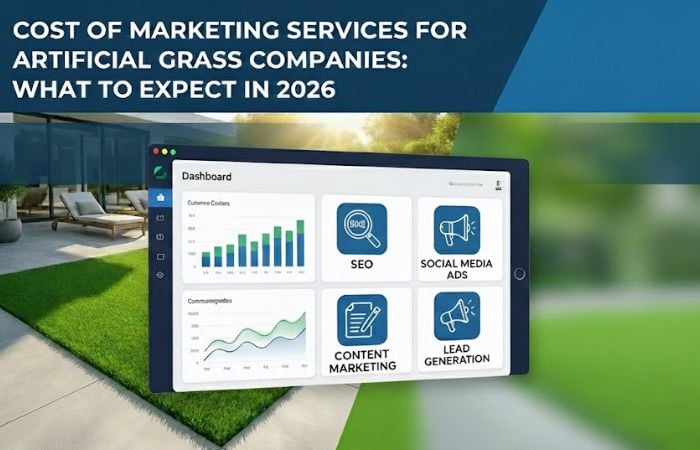
For artificial grass and turf installers, 2026 brings a rapidly shifting marketing landscape. Digital costs are climbing, and new AI-driven tools are completely reshaping how you plan and measure your budget. This article dives deep into marketing costs for turf businesses, breaking down the exact line items you should expect. We’ll show you how AI-powered marketing is transforming both expense categories and the unit economics for installers like you. You’ll get concrete budget allocations, clear pricing model comparisons, proven ROI calculation methods, and practical examples—all tailored for artificial grass companies ready to scale. We’ll also explore key 2026 trends like predictive analytics, Customer Data Platforms (CDPs), and real-time dashboards, explaining how they impact your long-term marketing baselines and operational spend. Plus, you’ll find tactical guidance on vendor selection and transparent pricing, empowering owners and marketing leads to confidently compare providers and minimize risk when adopting AI. Our focus throughout is on actionable, industry-specific advice for artificial grass businesses aiming for predictable leads, reduced overhead, and measurable ROI.
Breaking Down Your Marketing Costs: Key Components for Artificial Grass Companies
Your marketing spend as an artificial grass company boils down to a core set of recurring and one-time costs. Together, these components shape your total acquisition costs and, ultimately, your profitability. We’re talking about platform fees for marketing technology, initial setup and integration work, ongoing managed services and creative production, direct advertising spend (PPC, social, display), and the crucial analytics or data integration costs that fuel measurement and optimization. Grasping each item and its typical range is vital. Why? Because some costs scale predictably with your locations and job value, while others fluctuate based on market competition or seasonal demand. The smart first step for any turf installer is to clearly separate your fixed platform and setup fees from your variable ad and service costs. Then, model how these components directly influence your cost per lead and cost per booked install. Below, you’ll find a concise line-item comparison—a handy tool for owners to benchmark proposals and build predictable budgets before negotiating with vendors or jumping into new marketing platforms.
| Component | Cost Type | Typical Range |
|---|---|---|
| Platform Fees (Your Marketing Platform Subscription) | Recurring Subscription / Per-Location | $300–$2,000+/mo (Varies by Features & Scale) |
| Setup & Integration (One-Time Investment) | One-Time Implementation / Per-Location Onboarding | $500–$8,000 One-Time (Depends on Integrations) |
| Managed Services (Campaigns, Content, Optimization) | Monthly Retainer / % of Ad Spend | $800–$5,000+/mo OR 10–20% of Ad Spend |
| Advertising Spend (PPC, Social, Display) | Variable Media Buy | $1,000–$20,000+/mo (Market & Goals Dependent) |
| Analytics & Integrations (CDP, Tracking, Reporting) | One-Time + Recurring | $200–$1,500+/mo (Plus Setup Costs) |
This breakdown clearly shows how platform and setup fees establish your foundational cost, while your ad spend and managed services are what truly drive scale. Up next, we’ll walk you through how to amortize setup costs and calculate the real monthly overhead these fees introduce.
Platform Fees & Setup Costs: What’s Their Real Impact on Your Marketing Budget?
Platform fees and setup costs lay the groundwork—the fixed infrastructure that powers your digital campaigns, automation, and crucial measurement. They essentially set your baseline marketing expense, no matter your ad volume. Platform subscriptions often come in tiers, based on features, number of locations, or contact volume. Setup fees, on the other hand, cover the labor for integrations, tracking, and getting your initial campaigns built. To see the true monthly impact, amortize one-time setup costs across a 12–24 month contract. For instance, a $6,000 implementation spread over 12 months adds $500/month to your baseline. Compare this directly to the incremental leads you expect from better tracking and automation. When you’re reviewing proposals, always demand clear descriptions of what setup actually includes—things like data migrations, tracking configuration, creative production, and any Customer Data Platform integrations. Get timelines and acceptance criteria in writing. When comparing platform fee structures, you need to model both short-term and long-term scenarios. Why? Because a more robust upfront setup with comprehensive integrations often reduces variable costs and wasted ad spend over time. Understanding these trade-offs empowers installers to choose wisely: prioritize a lower initial outlay or aim for faster time-to-value with a more complete implementation.
Advertising Spend: The Engine Driving Your Turf Company’s Marketing Costs?
Advertising spend is usually the biggest, most dynamic line item for artificial grass companies. It’s typically what fuels your lead volume and dictates the pace of your business growth in a service-based market. Your ad spend covers everything from PPC and social media advertising to display and programmatic buys, and often even offline channels for local outreach. Keep in mind, your Cost Per Click (CPC) and Cost Per Lead (CPL) will fluctuate significantly based on geography, competition, and seasonality. Smart turf companies set CPL targets directly tied to their average job value and conversion rates. For example, if an average install brings in $6,000 and your lead-to-booked-job conversion is 3%, a $200 CPL could be perfectly acceptable if it leads to profitable installs after accounting for labor and materials. Regional benchmarks are your friend here: high-density, competitive metros will push CPCs higher, while suburban and rural markets might offer lower CPLs but potentially smaller lead volumes. We recommend modeling sample scenarios—low spend ($1k–$3k/mo), mid-tier ($5k–$15k/mo), and growth ($20k+/mo)—complete with expected lead volumes, CPL targets, and downstream conversion assumptions. This helps you accurately forecast ROI and cash flow needs. With clear budget-to-lead modeling, advertising spend becomes a powerful, controllable lever for your business, not just a mysterious expense.
How AI-Powered Marketing is Reshaping Artificial Grass Costs in 2026
AI-powered marketing is fundamentally reshaping your cost structures. It does this by automating routine tasks, dramatically boosting targeting efficiency, and introducing innovative vendor pricing models that are tied to value, not just hours or media costs. AI slashes lead qualification costs by rapidly screening inbound interest and routing high-intent prospects directly to your sales team. It cuts labor for first-response and scheduling with smart AI receptionists, and it optimizes your ad spend using predictive models and continuous learning. Of course, AI also introduces new cost items like licensing for AI components, dedicated training and optimization efforts, and data integration work to feed these powerful models. The net effect in 2026 is often a clear shift from labor-heavy recurring costs towards more subscription and performance-oriented fees. This significantly improves your unit economics when AI is properly trained and integrated. When you’re evaluating AI, you should always compare your pre-AI and post-AI cost per qualified lead. Calculate the payback period on your AI investment by measuring increases in conversion rate, faster lead-to-install speeds, and a clear reduction in manual hours. Here’s a quick look at the primary ways AI impacts each cost line, with concise examples to show the real difference.
- AI slashes routine lead qualification costs by a significant 30–60% through smart automation and prioritization.
- An AI receptionist and automation can effectively replace overnight coverage and first-response roles, measurably reducing your staffing overhead by hours each week.
- Predictive targeting intelligently trims wasted ad spend by refining audience selection and bid strategies, potentially lowering your CPL by 10–25%.
- AI licensing and training introduce a recurring cost, typically $200–$2,000+/mo, depending on the capabilities and scale you need.
These shifts demand careful modeling, as savings will accrue differently across your operations and marketing channels. In the next sections, we’ll dive into specific pricing models and labor-savings calculations.
AI Lead Generation & Qualification: Understanding the Pricing Models
AI lead generation vendors typically present three core pricing models: subscription, pay-per-qualified-lead, and hybrid arrangements that blend a base fee with performance compensation. A subscription model offers predictable monthly costs, often bundling platform access, essential AI lead scoring, and a suite of included automations. The pay-per-qualified-lead model shifts more risk to the vendor, aligning costs directly with delivered outcomes, though it can come with a higher per-lead price. This model absolutely requires robust definitions of “qualified” and crystal-clear lead ownership terms. Hybrid models cleverly mitigate risk by combining a lower subscription with reduced per-lead fees, striking a balance between cost predictability and performance incentives. When you’re evaluating these models, your turf company must inquire about lead quality guarantees, real-world sample conversion rates, lead ownership and CRM handoff protocols, and how duplicates or low-quality leads are managed. Crucially, service-level expectations—like response time SLAs and data access—should be explicitly written into your contracts. This prevents disputes and ensures the AI provider’s success metrics are perfectly aligned with your installation business’s revenue goals.
AI-Driven Multi-Channel Marketing Strategies for ROI
In an increasingly digitized and data-saturated marketplace, the integration of multi-channel marketing strategies has become essential for organizations aiming to enhance customer engagement, streamline user experiences, and improve return on investment (ROI). This systematic review examines the evolution and effectiveness of integrated digital marketing approaches by synthesizing findings from 85 peer-reviewed studies published between 2005 and 2022. It investigates how the convergence of strategic channel coordination, artificial intelligence (AI)-driven personalization, CRM and CDP infrastructure, behavioral retargeting mechanisms, and ethical data governance collectively influence digital marketing performance across industries and platforms. The review reveals that channel orchestration—defined as the coordinated deployment of marketing messages across platforms such as email, mobile applications, websites, social media, and offline touchpoints—consistently leads to impro
MARKETING CAPSTONE INSIGHTS: LEVERAGING MULTI-CHANNEL STRATEGIES FOR MAXIMUM DIGITAL CONVERSION AND ROI, AJ Mou, 2024
AI Receptionists & Automation: Your Secret Weapon for Lowering Overhead
AI receptionists and marketing automation are game-changers for reducing overhead. They expertly manage first contact, scheduling, follow-ups, and all those repetitive qualification steps that typically eat up human hours and introduce delays that kill conversion rates. Imagine an AI receptionist working 24/7, capturing leads even outside business hours. This dramatically reduces missed opportunities and creates a smooth, consistent lead flow right into your booking pipelines. To quantify your savings, start by tallying the human hours replaced and then estimate the improvements in your lead-to-booked-job conversion. For instance, swapping out four hours of human reception per weekday with an AI receptionist handling intake and qualification could free up a whopping 80 labor hours a month! That valuable labor can then be redeployed into sales or operations, or translate into direct payroll savings. Automation workflows—like automated follow-up sequences and contract generation—actively shorten sales cycles and reduce friction, which directly boosts your close rates and average revenue per lead. Always compare the effective cost for these tools against your labor savings plus the incremental revenue from faster responses and higher conversions to pinpoint the net benefit over a 6–12 month period.
Expected ROI & Cost Savings: What AI Marketing Delivers for Artificial Grass Businesses
To truly calculate the ROI for AI marketing, you need a clear baseline and smart, conservative assumptions. Your typical inputs will include current leads per month, your conversion rate to installs, average job value, and your current marketing costs. Our ROI framework directly compares the incremental revenue generated after AI adoption against the total sum of AI-related costs (platform fees, training, and any additional ad or integration spend). Many turf businesses unlock ROI from AI through three key pathways: significantly higher lead quality (boosting conversion), dramatically lower lead handling costs (reducing labor), and superior ad efficiency (lowering CPL). While benchmarks vary, realistic scenarios frequently show payback periods of just 3–12 months when AI improves conversion by even a few percentage points or materially reduces wasteful ad spend. Here’s a compact summary of ROI scenarios and typical outcomes that installers can easily adapt to their own numbers when modeling investments.
| Use Case | Cost Savings | Revenue Uplift |
|---|---|---|
| AI Lead Qualification | Reduced Labor; Fewer Low-Quality Leads | 10–30% Boost in Qualified Leads |
| AI Receptionist + Scheduling | Less After-Hours Staffing; Faster Response | 5–15% Higher Conversion Rate |
| Full Automation with SmartFlows | Less Wasted Ad Spend; Quicker Payback | 15–40% Total Revenue Improvement |
These scenarios vividly illustrate how cost savings truly compound: better qualification means less wasted ad spend, which directly lowers your CPL and significantly boosts your ROI. Next, we’ll walk you through a practical ROI formula and real-world case vignettes to clearly show you the math.
Calculating Your ROI from AI-Powered Lead Generation: A Simple Guide
Your ROI calculation begins with a straightforward formula: (Incremental Revenue – AI Investment) / AI Investment. Incremental revenue is simply (additional qualified leads × conversion rate × average job value). To put this into action, first gather your baseline metrics: current monthly leads, your current conversion rate to booked jobs, and your average install value. Next, project conservative improvements—for example, a 20% increase in qualified leads and a 10% boost in conversion. Apply your average job value to estimate that incremental revenue, then subtract your total AI costs (annualized platform fees, amortized setup, managed services). Let’s look at a worked example: if your baseline monthly leads are 100 with a 3% conversion and a $6,000 average job value, your baseline monthly installs are 3, generating $18,000 in revenue. A 20% uplift in qualified leads and a conversion boost to 3.3% would yield roughly 3.3 installs per month—that’s an incremental revenue of $1,800 monthly. If your AI investment costs $600/month (platform + amortized setup), your monthly ROI would be (1,800 – 600) / 600 = 2.0, or a fantastic 200% monthly ROI. Always run a sensitivity analysis to test best- and worst-case assumptions. This helps you truly understand payback timelines and capital requirements.
Real-World Success: AI Marketing Case Studies for Cost Reduction & Revenue Growth
These short, anonymized case vignettes reveal powerful, transferable patterns for turf installers: enhanced lead qualification consistently slashes wasteful ad spend, AI receptionists virtually eliminate missed bookings, and end-to-end automation dramatically shortens sales cycles. Consider one mid-sized installer who adopted an AI qualification layer. They experienced a remarkable 25% reduction in unqualified leads and a 12% increase in booked installs within just six months, effectively lowering their CPL by 18% once the AI model fully matured. Another regional firm implemented 24/7 AI receptionist handling and reported significantly reduced after-hours staffing needs, plus a 9% boost in same-week bookings thanks to lightning-fast response times. A more comprehensive adoption—integrating workflow automation and predictive targeting—generated combined media efficiency gains. This allowed the firm to strategically reallocate 15% of its budget into new growth markets while still hitting its cost-per-install targets. While exact percentages will naturally vary by market and implementation quality, these vignettes clearly demonstrate that measurable savings and significant revenue uplifts are absolutely achievable with disciplined measurement and continuous iteration.
Planning Your 2026 Marketing Budget: A Smart Approach for Artificial Grass Companies
Crafting your 2026 marketing budget means first setting clear goals (think lead volume, booked installs, and revenue targets). Then, you’ll strategically allocate your spend across predictable categories: platform and AI tools, advertising media, managed services and creative, SEO/CRO, and a smart contingency for testing. Your allocation should always mirror your business size and growth stage. Startups, for instance, will need more focus on demand generation, while established installers will pivot towards optimization and expanding into new geographies. Key factors that must influence your budget include average job value, sales cycle length, local competition intensity, and the inherent seasonality of installations. We recommend a phased approach: pilot AI tools with a controlled ad spend, meticulously measure the impact, and then scale. This strategy effectively mitigates risk and protects your cash flow. Below, you’ll find a practical allocation template that installers can easily customize for their specific stage and goals. It clearly shows how to distribute percentage-based budgets to hit your precise KPI objectives.
| Monthly Budget Level | AI Tools & Platform Allocation | Expected Leads / Conversion (Monthly) |
|---|---|---|
| Conservative ($3k/mo) | 15% ($450) | 20–40 Leads / 2–3% Conversion |
| Growth ($10k/mo) | 20% ($2,000) | 60–200 Leads / 3–5% Conversion |
| Scale ($25k+/mo) | 25% ($6,250+) | 200+ Leads / 4–6% Conversion |
This template is designed to help your business strategically decide how much to allocate for AI and platform fees versus media spend. The following subsections will then unpack the crucial variables that should inform those choices.
Key Factors Influencing Marketing Spend for Synthetic Turf Installers
Several critical factors dictate the ideal marketing spend for installers like you: market competition, local search demand, project seasonality, your average job value, and whether your business targets residential, commercial, or sports turf segments. High-competition metro areas, for example, demand higher per-lead bids and more substantial budgets to secure meaningful lead volumes. Conversely, high average job values can justify higher CPL targets because each closed install delivers significantly greater revenue. Seasonality naturally compresses lead windows, so smart installers budget for off-season nurturing and out-of-season promotions to ensure pipeline stability. Your sales cycle length directly impacts cash flow—longer cycles mean sustained nurturing spend—so businesses must plan for conversion delays and strategically allocate funds for remarketing and lead retention. This checklist of factors will help you prioritize exactly where to invest and how aggressively to bid for leads in any given market.
- Market Competition Intensity
- Average Job Value & Margins
- Seasonality & Installation Windows
- Sales Cycle Length & Follow-Up Costs
- Geographic Scale & Multi-Location Needs
These crucial variables will guide your decision: whether to front-load your platform investment or conservatively test AI tools before a full roll-out.
Allocating Your Budget: AI Solutions vs. Traditional Marketing Channels
Practical budget allocation models naturally differ based on your company’s maturity. Below, we’ve outlined three sample mixes and their rationale to help installers like you choose a blend that perfectly balances experimentation, predictable lead flow, and operational improvements. Startups, for instance, will typically prioritize ads to quickly prove demand. Growth-stage installers will strategically add automation to scale efficiently. And established multi-location installers will invest more heavily in platforms and analytics to truly optimize ROI across all their regions. Your allocation should always be revisited quarterly, based on real performance data, with clear rules for rebalancing funds towards your highest-performing channels or scaling AI features that demonstrably reduce CPL or boost conversion.
- Startup: 60% Ads, 20% Platform/AI, 10% SEO/CRO, 10% Creative/Testing.
- Growth: 50% Ads, 25% Platform/AI, 15% SEO/CRO, 10% Managed Services.
- Enterprise/Scale: 40% Ads, 30% Platform/AI, 20% SEO/CRO/Analytics, 10% Contingency & Expansion.
Remember, these allocations are excellent starting points. The truly critical practice is to tie every single percentage to your expected leads and ROI. This ensures reallocation happens based on observed unit economics, not just intuition.
Latest 2026 Marketing Trends: What They Mean for Artificial Grass Industry Costs
Several powerful market trends in 2026 are directly impacting marketing costs and where value is truly captured. First, the broader democratization of AI means advanced tools are now accessible to even smaller installers. Predictive analytics are enabling smarter budget allocation and more precise lead scoring. And Customer Data Platforms (CDPs) are unifying data to dramatically reduce wasted ad spend through superior personalization. Demand-side platforms and programmatic buying are increasingly automating bid decisions, significantly compressing the manual labor once needed to manage complex media campaigns. As more providers roll out AI features, competitive differentiation is shifting. It’s no longer about raw feature lists, but about implementation quality and robust measurement capabilities. While these trends ultimately lower long-term marginal costs for well-instrumented businesses, they also raise the bar for data hygiene and integration efforts, which can introduce initial expenses. In the following sections, we’ll dive deeper into predictive analytics and CDPs, exploring their unique cost-benefit dynamics.
Predictive Analytics: Shaping Your Marketing Investments for Turf Businesses
Predictive analytics leverages historical and behavioral data to intelligently score leads, accurately forecast conversion probability, and precisely optimize media allocation. This means shifting your spend directly to the prospects most likely to book. Implementation costs involve data integration, model training, and continuous validation. However, even a modest prediction lift—say a 5–15% improvement in prioritized conversion—can significantly lower your average CPL by funneling your ad spend towards truly higher-value audiences. Typical predictive use cases for turf firms include smart lead prioritization (your sales team gets the highest-likelihood leads first), churn prediction for maintenance contracts, and creating powerful lookalike audiences for paid media campaigns. Key KPIs to monitor post-implementation include the lift in your qualified lead rate, reduction in ad churn, and the payback period on your analytics investment. While these powerful models do require clean data and continuous calibration, the ultimate outcome is far more predictable budgeting and dramatically more efficient media dollars for your business.
Predictive Analytics for Lead Generation and Marketing Efficiency
By the end of this review, it will be clear how the integration of predictive analytics into lead generation strategies is revolutionizing marketing and providing companies with a significant
Advances in lead generation and marketing efficiency through predictive campaign analytics, JC Ogeawuchi, 2022
Customer Data Platforms (CDPs): Your Key to Cost-Effective Marketing
Customer Data Platforms (CDPs) are designed to consolidate all your first-party data—think lead forms, CRM records, service history—into one unified layer. This empowers you to achieve segmentation and personalization at scale, dramatically reducing wasted ad spend through much cleaner audience targeting. While CDPs do involve integration costs and governance work, they pay significant dividends by boosting match rates, ensuring consistent messaging across all your channels, and powering advanced predictive models or SmartFlows. For turf installers, a CDP can be a game-changer: it identifies past customers ripe for referrals, segments your highest-value prospects, and feeds your ad platforms with superior, higher-quality audiences that directly lower your CPA. The ROI timeline for CDP adoption often hinges on your existing data fragmentation. Companies with numerous disparate data sources typically see faster benefits, whereas those starting from scratch will need to invest in cleanup and mapping first. The overarching strategic benefit is crystal-clear measurement and a significant reduction in duplicated spend across your various channels.
Choosing Your Ideal Marketing Service Provider for Artificial Grass in 2026
Selecting the right provider means rigorously evaluating transparency, feature fit, and measurable outcomes—not just sales promises. As an installer, you should demand crystal-clear, line-item pricing, access to sample dashboards or a detailed reporting cadence, firm SLA commitments for lead response and uptime, and concrete evidence of systems modeled after *truly* successful installers. Your feature checklist should definitely include AI assistants for lead qualification, an integrated contract builder, an AI receptionist for seamless 24/7 customer service, and real-time dashboards to actively monitor performance. Vendors who offer proven processes and robust visibility will significantly reduce your experimentation costs and dramatically speed up your time-to-value. Below, you’ll find a concise checklist of questions and red flags to guide your vendor selection, ensuring pricing perfectly aligns with your expected outcomes and accountability.
- Do you provide crystal-clear line-item pricing and a detailed breakdown of setup vs. recurring fees?
- Can you clearly demonstrate lead ownership, CRM handoff, and firm SLAs for response times?
- Is real-time dashboard access available, and what key KPIs are displayed?
- What specific features support automation (e.g., AI assistants, contract builder, AI receptionist)?
Pricing & Service Transparency: What Your Turf Business Deserves
Your turf business absolutely must demand transparency in pricing. This means an explicit separation of platform fees, setup, managed services, and ad spend, so you can accurately calculate your true cost per qualified lead. Your contracts should clearly outline performance metrics, reporting cadence, and precise definitions for lead qualification and ownership—this is crucial to prevent disputes. Watch out for red flags like vague descriptions such as “custom pricing” without concrete examples, no trial or pilot option, or any reluctance to share sample dashboards. A truly transparent provider will offer clear SLAs, a strategic roadmap for measurable outcomes, and the seamless ability to export your data and integrate with your existing CRMs. Demanding these essential elements ensures accountability and empowers installers like you to accurately model your ROI before committing to any long-term contracts.
What Makes AI-Powered Marketing Platforms Like AGM Stand Out?
The key differentiators for truly advanced AI platforms include comprehensive end-to-end automation, specialized role-specific AI assistants, seamless contract and workflow integration, and dynamic, live visibility into your performance. Take Artificial Grass Marketing (AGM), for instance. We position ourselves as a uniquely tailored lead generation marketing stack that puts a strong emphasis on AI-driven marketing automation and solutions built *specifically* for the artificial grass industry. Our platform is powered by C.O.R.E. 8 SmartFlows and features advanced AI assistants for precision lead qualification, an integrated contract builder, and an AI receptionist for flawless 24/7 customer service. These powerful capabilities directly impact your costs and ROI by automating qualification, significantly reducing administrative staffing needs, and dramatically speeding up your time-to-contract. This, in turn, lowers your effective CPL and boosts your conversion rates. When you’re evaluating providers, installers should carefully weigh whether feature sets like these are bundled into platform fees or offered as add-ons, and critically, how quickly the vendor can demonstrate *measurable outcomes* in pilot engagements.
Your Top Questions About Artificial Grass Marketing Costs in 2026, Answered
As a buyer, you’re likely asking about total cost ranges, the CPL you can expect after AI adoption, what percentage of your budget should be allocated to AI tools, and how quickly your investments will pay back. While direct answers always require specific assumptions, typical ranges and practical rules of thumb can certainly help set your expectations. The most impactful questions often revolve around defining a “qualified lead,” accurately estimating seasonal fluctuations, and clarifying data ownership and reporting protocols. Below, we’ve provided concise answers to the most frequent buyer queries, designed to support your quick decision-making and offer clear, scannable guidance.
- How much does it cost to start with AI marketing? Expect modest platform pilots ranging from a few hundred to a few thousand dollars per month, plus initial setup, depending on your desired scope.
- What CPL can installers really expect? Your CPL will vary widely by market. Always aim to benchmark against your average job value and use smart conversion modeling to set truly realistic CPL targets.
- How long until you see real ROI? With disciplined measurement and strategic pilot testing, many businesses experience payback within a solid 3–12 months.
These concise answers are designed to help you establish realistic expectations before diving into deeper financial modeling.
What’s the Investment to Market Your Artificial Grass Business with AI?
Your costs will naturally vary based on your market, company size, and the vendor model you choose. For smaller installers, a conservative monthly budget might range from $2k–$5k, which includes modest ad spend and a fractional AI platform allocation. Growth-oriented firms, however, often budget $10k–$25k+ to effectively capture larger geographic areas and scale their operations. AI-related costs typically encompass platform subscriptions (ranging from hundreds to thousands per month), initial setup and integration, and potentially per-lead fees, depending on the pricing model. Critical assumptions here include your average job value, conversion rates, and seasonality; these crucial inputs will determine your sustainable CPL targets. Our recommended responsible approach is to run a controlled pilot. This isolates the AI layer, measures incremental conversions, and allows you to scale your ad spend confidently, thereby significantly limiting your upfront risk.
Top Strategies to Maximize Your Marketing ROI as a Turf Installer
Maximizing your ROI means strategically combining improved lead quality, dramatically shortened lead response times, and optimized ad spend through continuous testing and data-driven allocation. Always prioritize conversion optimization and robust lead qualification automation before you scale your ad budgets. Why? Because a higher conversion rate from the same lead volume generates the same revenue with significantly lower spend. Actively encourage referrals and reviews to naturally lower your acquisition costs. Leverage remarketing to effectively recapture warm prospects, and implement solid measurement frameworks that directly tie every single lead back to revenue. Invest wisely in automation that reduces manual touchpoints and refines your follow-up cadence. Then, scale your media budgets selectively, based on proven channel performance and clear CPA targets. These strategies collectively create a powerful virtuous cycle: better quality leads lead to higher close rates, which in turn justifies even further investment in your growth.
AI Marketing: How It’s Transformed Cost Structures for Artificial Grass Companies
AI marketing has fundamentally shifted cost structures from traditional labor-centric models to highly efficient, technology-centric approaches. This means concentrating your spend on powerful platforms and integrations that dramatically reduce variable labor costs and truly enable scale. This transformation is clearly visible across three key dimensions: your lead-to-install workflows become standardized and streamlined, predictive analytics empower smarter budget allocation, and real-time dashboards provide instant visibility that significantly shortens decision cycles. Standardized processes, meticulously modeled after high-performing installers, drastically reduce the experimentation burden for new adopters. Meanwhile, intuitive dashboards make any wasted spend immediately visible and actionable. The net effect? A significantly lower marginal cost per install for companies that wisely invest in the right combination of platform capabilities, automation, and disciplined measurement. In the following subsections, we’ll explore these proven systems and the vital role of dashboards in driving efficiency.
Proven Systems: Modeled After Leading Turf Installers for Your Success
Proven systems are all about replicating highly effective lead-to-install workflows: from initial capture and automated qualification to seamless scheduling, efficient contract generation, and strategic post-install follow-up to secure those valuable referrals and reviews. By modeling your approach after leading installers, you drastically cut down on time spent on ad hoc process design and significantly shorten your ramp-up to profitable operations. Key workflow elements include standardized intake questions to precisely qualify scope and budget, automated assignment to your sales staff or AI assistants, integrated contract building to rapidly speed up approvals, and automated review requests after installation to continuously fuel your referral pipelines. Replicating these essential elements dramatically reduces variability and eliminates the costly trial-and-error new adopters often face. This empowers faster scaling with truly predictable unit economics. Businesses that embrace these standardized workflows consistently experience improved conversion consistency and much easier performance benchmarking across all their locations.
AI and Data Integration for Lawn Care Service Optimization
This article explores the transformative impact of digital technologies, artificial intelligence, and data integration on lawn care service operations. The article examines how weather-dependent service industries can leverage master data management systems, weather integration components, and AI-driven analytics to optimize resource allocation, improve customer retention, and enhance service delivery. The article demonstrates that implementing comprehensive digital transformation strategies results in significant improvements across multiple organizational dimensions, including operational efficiency, decision-making capabilities, and customer satisfaction. Through structured implementation methodologies encompassing data integration, AI model development, and system deployment, lawn care service providers can achieve measurable benefits in resource utilization, service timing accuracy, and overall business performance. The article highlights how predictive analytics and machi Leveraging Data Integration and AI for Intelligent Lawn Care Service Operations, SP Singh, 2025
Real-Time Dashboards: Boosting Your Marketing Efficiency & ROI
Real-time dashboards are your secret weapon, translating complex data into immediate, impactful decisions. This means you can instantly reallocate ad budgets to your best-performing campaigns, quickly flag rising CPLs, and immediately spot drops in lead response time that *kill* conversion. Critical KPIs you *must* monitor include CPL, conversion rate, lead response time, qualified leads per week, and revenue per lead. These powerful dashboards dramatically shorten your decision loop—when performance dips, your teams can act in days, not weeks. This directly reduces wasted media spend and significantly boosts your campaign ROI. Real-time visibility also fosters accountability across your teams and vendors, enabling lightning-fast troubleshooting of tracking issues or creative fatigue. It’s this powerful combination of standardized workflows and immediate visibility that truly allows AI-driven platforms to materially reduce your cost per booked install and stabilize your scaling efforts as an artificial grass company.
For installers like you, who are ready to truly explore AI-driven options, we recommend a measured pilot. This approach, with clear KPIs—think lead quality, CPL, conversion lift, and payback period—will provide all the data you need to confidently scale your investments. Artificial Grass Marketing (AGM) offers a uniquely tailored lead generation marketing stack, emphasizing AI-driven marketing automation and solutions built *specifically* for the artificial grass industry. Our platform is powered by C.O.R.E. 8 SmartFlows and includes advanced AI assistants for precision lead qualification, an integrated contract builder, and an AI receptionist for seamless 24/7 customer service. These powerful capabilities directly translate to reduced overhead and significantly improved conversion for your business. Ready to see it in action? Request a demo or consultation with a provider who can clearly demonstrate real-time dashboards, proven installer-modeled systems, and transparent pricing breakdowns. This will help you confidently determine if the platform perfectly fits your market and ambitious growth goals.
Your Frequently Asked Questions About Artificial Grass Marketing
What are the *real* benefits of using AI in marketing for artificial grass companies?
AI in marketing delivers a wealth of benefits for artificial grass companies, including dramatically enhanced lead qualification, precision targeting, and significantly reduced operational costs. By intelligently automating routine tasks, AI can streamline processes like lead screening and scheduling, freeing up your team to focus on higher-value activities. Plus, AI-driven analytics can powerfully optimize your ad spend by predicting exactly which audiences are most likely to convert. This ultimately leads to a lower Cost Per Lead (CPL) and a much higher Return On Investment (ROI). These efficiencies can profoundly impact your overall marketing effectiveness and boost your profitability.
How can artificial grass companies *truly* measure the success of their marketing campaigns?
Measuring the success of your marketing campaigns means diligently tracking key performance indicators (KPIs) like conversion rates, Cost Per Lead (CPL), and Return On Investment (ROI). Smart companies always establish clear baseline metrics *before* rolling out new strategies. This allows for accurate, apples-to-apples comparisons post-campaign. Leveraging real-time dashboards provides instant, actionable insights into campaign performance, empowering you to make quick adjustments and optimize your results. Furthermore, actively analyzing customer feedback and engagement metrics is crucial. It helps you refine future marketing efforts and ensures perfect alignment with your target audience’s needs.
What challenges might artificial grass companies encounter when adopting AI marketing tools?
Adopting AI marketing tools can certainly present a few challenges for artificial grass companies. These might include the initial investment for implementation, the critical need for robust data integration, and even potential resistance to change within your organization. Companies sometimes struggle with ensuring top-notch data quality and consistency, which are absolutely crucial for effective AI performance. Plus, there’s often a learning curve that comes with embracing new technologies, requiring dedicated training and adaptation. Overcoming these hurdles involves careful strategic planning, crystal-clear communication, and a firm commitment to ongoing evaluation and continuous improvement.
How can turf companies *strategically* allocate their marketing budget in 2026?
For turf companies, truly effective budget allocation in 2026 *must* factor in your business size, current growth stage, and local market competition. We highly recommend a phased approach: pilot AI tools with a controlled ad spend, meticulously measure their impact, and *then* scale based on proven performance. Strategically allocating funds across diverse channels—like AI tools, advertising, and creative services—ensures a well-rounded strategy that supports both immediate lead generation and vital long-term brand building. Regularly revisiting and smartly adjusting your budget based on real performance data is absolutely essential for maximizing your ROI.
What vital role does customer feedback play in shaping marketing strategies for artificial grass companies?
Customer feedback is absolutely vital for shaping marketing strategies for artificial grass companies. It provides invaluable insights into your customer preferences, their specific pain points, and overall satisfaction levels. By actively soliciting and thoroughly analyzing this feedback, your company can perfectly tailor its messaging, continuously improve service offerings, and significantly enhance customer experiences. This level of responsiveness not only helps you refine your marketing campaigns but also powerfully fosters customer loyalty and actively encourages valuable referrals. Incorporating robust feedback loops into your marketing strategies ensures that your company remains perfectly aligned with your audience’s evolving needs and can swiftly adapt to changing market dynamics.
What are the long-term implications of AI adoption for marketing in the artificial grass industry?
The long-term implications of AI adoption for marketing in the artificial grass industry are truly transformative. Expect to see significantly increased operational efficiency, vastly improved customer targeting, and powerfully enhanced data-driven decision-making. As companies seamlessly integrate AI tools, they can anticipate a clear shift from labor-intensive processes to far more automated, scalable solutions. This strategic transition will lead to lower marketing costs and consistently higher conversion rates over time. Furthermore, businesses that effectively leverage AI will undoubtedly gain a sharp competitive edge. They’ll be able to respond much more quickly to market changes and evolving customer demands, ultimately driving robust, sustainable growth.
Ready to Grow? Your Next Steps with AI Marketing
Understanding the true cost dynamics of marketing services for artificial grass companies isn’t just important—it’s absolutely essential for optimizing your budget and maximizing your ROI. By strategically adopting AI-driven tools and smart strategies, your business can dramatically improve lead quality, significantly lower overhead, and powerfully enhance operational efficiency. This isn’t just about saving money; it’s about paving a clear path for sustainable growth. As you plan your marketing budget for 2026, we urge you to seriously consider incorporating advanced technologies. This is how you’ll maintain a sharp competitive edge in today’s fast-evolving market.
Ready to see these strategies in action? Book a demo with our experts today and discover how our tailored solutions can elevate your marketing performance and drive measurable results.