
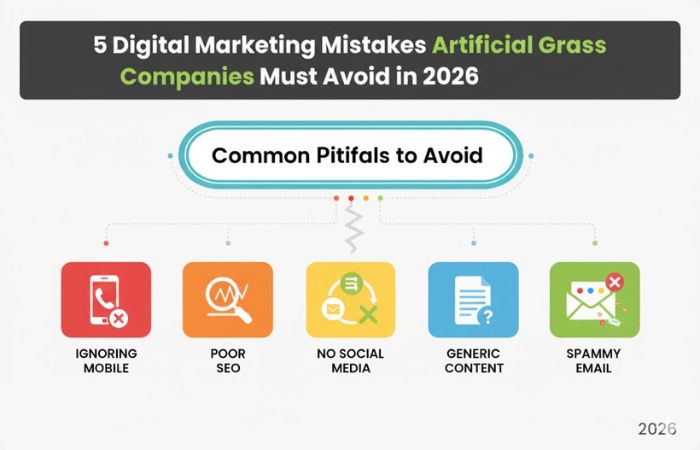
In 2026, artificial turf businesses that proactively sidestep common digital marketing pitfalls will capture more high-quality leads and scale their operations profitably. This essential guide reveals which errors are costing you installations and how AI-enabled solutions can recover lost revenue. You’ll discover how mobile experience failures, weak local SEO, generic content, ignored AI automation, poor reputation management, and missing KPI tracking directly slash bookings and profit margins for artificial grass companies. This article clearly links these mistakes to measurable business impacts, provides tactical fixes specifically for installers and landscapers, and highlights where AI tools like SmartFlows and AGMPro+ can seamlessly plug gaps in your sales funnel. Each section below dives deep into a critical failure point, offering practical checklists, quick wins, and clear methods to measure outcomes using C.O.R.E. KPIs and intuitive dashboards. Read on for actionable mobile optimization strategies, powerful SEO and Google Business Profile tactics, smart social media and content personalization approaches, ROI-tracking tables, real-world AI use cases for 24/7 lead handling, automated reputation management workflows, and a clear implementation roadmap for staged adoption. Our goal is to transform theoretical marketing advice into concrete, measurable steps your artificial grass business can implement this year for significant growth.
Why Avoiding Digital Marketing Mistakes is Crucial for Artificial Grass Companies in 2026
Steering clear of digital marketing missteps is absolutely critical because today’s competitive landscape and buyer expectations demand instant, localized, and personalized experiences. This shift strongly favors responsive, data-driven turf brands. These common mistakes directly lead to lost inquiries, wasted advertising dollars, and drawn-out sales cycles, ultimately hindering your ability to scale installation teams profitably. By 2026, homeowners expect immediate answers, local proof, and frictionless mobile booking options. Companies that fail to adapt will inevitably see declining contact rates and lower close rates. Understanding these market dynamics empowers your business to prioritize fixes that deliver tangible ROI and sustain long-term growth. The following sections will quantify these cost categories and outline current market trends to help you prioritize your actions effectively.
What Are the Real Costs of Common Marketing Errors for Your Turf Business?
Marketing errors for artificial turf installers manifest in four distinct cost categories: lost revenue from missed leads, inefficient ad spend, operational waste from manual follow-up, and long-term reputational damage that shrinks your referral volume. Missing or responding slowly to online leads often means losing a high-intent homeowner directly to a nearby competitor, which immediately reduces your booked-job volume and average deal value. Inefficient ad spending—paying for clicks that don’t convert because your landing pages or mobile forms fall short—inflates your cost-per-acquisition and drains your budget from more profitable channels. These operational and reputational costs accumulate over time, making prompt fixes to your lead capture, follow-up automation, and local proof generation absolutely essential for protecting your margins and fueling growth. Addressing these critical areas will empower your business to reallocate resources toward high-yield optimizations.
How is the Artificial Grass Market Evolving and Impacting Your Marketing Strategies?
The artificial grass market is rapidly becoming more localized, visually driven, and service-centric. Buyers are increasingly prioritizing installers who demonstrate timely communication, transparent pricing, and compelling visual evidence of their projects. Current buyer behavior heavily favors mobile research, social validation (like stunning installation photos and glowing reviews), and the expectation of rapid scheduling options. Therefore, your marketing must emphasize a mobile-first user experience, strong local SEO signals, and abundant social proof. As AI-powered tools enable faster lead qualification and instant responses, firms that embrace automation will capture more initial contacts and convert them into booked jobs with significantly less manual effort. These trends mean your marketing strategies should pivot from generic awareness ads to optimized local intent capture, well-structured service pages, and personalized follow-up sequences that truly reflect specific buyer needs. The resulting competitive edge comes not just from better traffic, but from dramatically higher conversion rates and lower acquisition costs.
Top Mobile Optimization Mistakes Turf Companies Can’t Afford to Make
Mobile optimization mistakes are particularly costly because the vast majority of local turf searches and initial inquiries now originate from phones. Failing to prioritize mobile user experience (UX) and performance directly slashes your contact rates and significantly increases bounce rates. Common errors include painfully slow page loads due to unoptimized images, clunky mobile forms that create unnecessary friction, and unclear Calls-to-Action (CTAs) that don’t effectively guide a homeowner to schedule an estimate or request a quote. A mobile-first design strategy focuses on fast, easily scannable content, tap-friendly actions, and contact paths that can be completed in three taps or fewer. This approach dramatically improves conversion and minimizes lead leakage. The following list pinpoints the primary mobile problems and offers immediate, actionable fixes that your turf company can apply to both your website and paid landing pages.
Here are the most critical mobile UX issues and how to resolve them:
- Slow page loads: Compress your images, utilize modern file formats, and lazy-load large project galleries to drastically reduce time-to-interact.
- Bulky forms: Replace lengthy forms with progressive capture methods and single-field starting points that prioritize collecting a phone number or address first.
- Unclear CTAs: Implement prominent, localized Calls-to-Action like “Schedule Your Local Estimate” with direct tap-to-call and integrated calendar options.
- Non-responsive content: Ensure all service pages reflow perfectly on smaller screens and that videos/images scale appropriately without obscuring vital information.
Implementing these fixes will significantly reduce friction and boost your mobile conversion rates, naturally leading to higher quality leads and increased booking rates.
Why is Mobile-First Design Indispensable for Artificial Grass Websites?
Mobile-first design is absolutely indispensable because most household decision-makers search for and contact local installers directly from their phones. Mobile-first experiences consistently convert at higher rates when they minimize friction and emphasize immediate action. A truly mobile-first site prioritizes your most critical content—service areas, clear pricing cues, compelling project photos, and one-touch lead capture—allowing users to quickly evaluate your fit and take action without the need for desktop navigation. Fast mobile performance not only reduces bounce rates but also significantly improves your local search rankings. Clear tap targets and simplified forms directly increase contact rates and appointment bookings. For turf companies, a mobile-first approach should prominently showcase stunning before/after visuals and provide an effortless path to request an on-site estimate, thereby accelerating the buyer journey from initial awareness to a confirmed booked job. Implementing these design patterns will create a measurable uplift in your contact-to-booking conversion and shorten your sales cycles.
How Does AGM’s Platform Ensure Seamless Mobile-Friendly Lead Capture?
Artificial Grass Marketing Company expertly closes mobile lead capture gaps by integrating mobile-optimized SmartFlows lead forms with powerful AGMPro+ AI Assistants that engage prospects instantly and qualify them automatically. SmartFlows delivers intelligently designed mobile flows that minimize required fields and support progressive data collection, while AGMPro+ can manage inbound inquiries 24/7, ensuring immediate initial contact even outside of standard business hours. This seamless integration dramatically improves your contact rate by reducing lead leakage and automating qualification steps that previously relied on slow, manual callbacks. The result? Faster appointment scheduling, a higher lead-to-booked-job conversion rate, and a smoother, more satisfying mobile experience for homeowners. For installers eager to see a hands-on demonstration of how these mobile flows protect your contact rates and accelerate qualification, scheduling a product walkthrough will clearly illustrate the entire end-to-end mobile capture and qualification path.
How Ineffective SEO Strategies Harm Your Artificial Grass Business
Ineffective SEO strategies severely hurt turf businesses by drastically reducing your visibility for local, purchase-intent searches and by failing to present your service offerings to nearby buyers precisely when they’re ready to hire. SEO errors such as weak local targeting, thin service pages, missing structured data, and poor technical performance will diminish your organic traffic and force a greater reliance on paid channels, which often come with higher acquisition costs. An artificial turf company that overlooks local intent keywords and crucial Google Business Profile signals will inevitably lose high-intent searchers to competitors who appear prominently with clear service-area pages, compelling project photos, and strong review signals. Addressing your keyword strategy, technical SEO, and structured data will significantly increase your discoverability, improve click-through rates, and elevate the quality of your inbound leads. The following sections provide a tactical checklist of common SEO mistakes and explain how optimized Google Business Profile management can dramatically improve your local visibility.
What Are the Most Common SEO Mistakes Artificial Turf Companies Make?
Artificial turf companies frequently make SEO mistakes that include neglecting to build dedicated service-area pages, using generic copy that doesn’t align with specific buyer intent, and omitting structured data that helps search engines truly understand your installation services. Many installers mistakenly rely on a single, sparse homepage instead of creating city- or neighborhood-level pages that perfectly match queries like “synthetic turf installer near me” or “artificial grass for backyard in [city].” Technical oversights—such as missing meta descriptions, slow page speed, and failing to implement Service or HowTo schema—drastically reduce your chances of appearing in rich results and voice search. Corrective actions include thoroughly auditing your keyword intent, crafting localized service pages with unique project photos and authentic testimonials, implementing schema markup for your services and projects, and resolving technical performance issues to boost crawlability. These steps will significantly raise your organic visibility and ensure your traffic directly aligns with revenue-driving queries.
Key SEO corrections you should prioritize:
- Create distinct service-area pages, rich with local signals and compelling project galleries.
- Optimize your page titles, headers, and meta descriptions specifically for turf-related search terms.
- Add structured data (Service, Product, HowTo) to significantly improve your eligibility for rich results.
- Fix technical speed and crawlability issues to boost your indexation and search rankings.
Applying these crucial corrections will increase your qualified organic leads and reduce wasted ad spend.
The importance of local optimization for search engines to increase organic traffic and visibility is well-documented.
SEO and Local Optimization for Retailers: Boosting Visibility and Traffic
Introduction. Digital transformation and the high level of offline and online competition have a significant impact on business, which emphasizes the relevance and need to implement the successful relevant marketing strategy that includes the search engine optimization (SEO). The SEO increases the business visibility on the Internet in comparison with priority competitors, promotes better communication and interaction in accordance with varied requests of online buyers (customers, clients). SEO is especially important for successful retailers’ business characterized by constant bifurcations in the short and long term.The Purpose of the presented research is to substantiate the importance of the local optimization of the retailer’s business for search engines to increase organic traffic; to represent insights and give practical recommendations for retailers regarding local optimization of their business in Google as part of an effective marketing strategy; to create the typical valid data micromarking (by the example of the Ukrainian retailer), which will contribute to an advantageous placement in the Local Pack in comparison with competitors, and increase organic traffic and conversion.
How Optimizing Your Google Business Profile Can Dramatically Improve Local Visibility
Optimizing your Google Business Profile (GBP) significantly boosts local visibility by providing consistent business information, recent project photos, detailed service listings, and active review management. Together, these elements dramatically increase your local relevance and click-through rates. A fully complete GBP includes detailed service descriptions, category selections precisely tailored to artificial grass installation, and frequent posts that highlight recent projects or special promotions. These elements directly influence your local pack placement and build user trust. Actively soliciting timely reviews and responding promptly to customer feedback will increase your average ratings and provide fresh content that GBP algorithms highly value. Monitoring your GBP metrics and aligning your website content—specifically service pages and project galleries—with top-performing GBP queries creates a powerful, convergent signal that dramatically improves local search performance. While direct linking isn’t the focus here, installers must ensure their GBP is thoroughly filled out, frequently updated, and tightly aligned with their site content for maximum impact.
Leveraging Google Business Profile is a key strategy for small businesses aiming to expand their online reach.
Why Poor Social Media Engagement is a Major Marketing Pitfall for Turf Companies
Poor social media engagement is a significant pitfall because project-driven services like artificial grass installations thrive on visual proof and word-of-mouth referrals. Social platforms are prime channels for showcasing stunning transformations and generating valuable leads. Treating social media as merely a one-way broadcasting tool, and failing to actively solicit or promote user-generated content, will reduce your referral potential and erode trust with local audiences. Consistent, meaningful engagement—such as responding to comments, sharing captivating short installation clips, and promoting neighborhood-specific posts—can transform passive followers into warm leads and powerful referral sources. Furthermore, your social content can strategically feed into structured site content and GBP posts, reinforcing your SEO and reputation signals. The following sections offer concrete content ideas and explain how automation can effectively distribute social proof to significantly increase your referrals.
How Can Your Turf Company Build a Thriving Social Media Community?
Building genuine social media engagement requires a dynamic content mix that highlights impressive project outcomes, educates prospective clients, and actively invites community participation. This must be combined with a consistent posting cadence and diligent, active responses to comments. Post types that consistently perform well for turf companies include captivating time-lapse installation videos, stunning before-and-after carousels, authentic homeowner testimonial clips, practical maintenance tips, and localized promotions that encourage tagging neighbors. Engaging formats like polls, interactive Q&A sessions about turf benefits, and requests for user photos after installation will stimulate interaction and generate valuable social proof. A simple content calendar with weekly themes—such as a project showcase, a customer success story, a tip day, and a local spotlight—will keep your feeds fresh and encourage sharing. By effectively converting social interactions into leads—through clear Call-to-Action prompts to request a quote or schedule an estimate—your social engagement becomes a measurable, integral part of your sales funnel.
Practical post ideas for an eight-week cycle:
- A captivating time-lapse installation highlight of a complete backyard transformation.
- An authentic customer testimonial video featuring your product and a shout-out to your installer.
- A helpful maintenance tip post demonstrating quick and easy care routines.
- A local spotlight post showcasing a recent neighborhood project and a special community offer.
How Does AGM Automate Social Proof and Supercharge Referrals?
AGM leverages the powerful capabilities of AGMPro+ to automate review requests and strategically distribute testimonials across the web and various social channels. This significantly reduces manual follow-up and scales your social proof generation effortlessly. Automated workflows proactively prompt post-installation review solicitation, then capture responses and intelligently suggest short-form testimonial content perfectly suited for social sharing or Google Business Profile updates. This automation dramatically increases the volume and consistency of your reviews, empowering installers to showcase recent projects with minimal operational overhead. The resulting uplift in review volume and visible testimonials strengthens local trust and significantly improves referral rates, making word-of-mouth amplification far more reliable. Combining automated review capture with the manual curation of high-impact project visuals yields a continuous stream of compelling social proof that supports both organic visibility and robust social engagement.
The Risks of Generic Content vs. the Power of Personalized Marketing
Relying on generic content risks alienating distinct buyer segments—from residential homeowners to commercial landscapers and property managers—because a one-size-fits-all message simply fails to address their unique priorities, whether it’s durability, budget, maintenance, or aesthetics. Generic content consistently underperforms in both paid and organic channels, resulting in lower engagement and conversion rates because it lacks targeted value propositions for each specific persona. Personalized marketing, however, dramatically increases relevance, click-through rates, and email performance by aligning content with specific decision criteria and each stage of the buyer journey. AI enables scalable personalization that tailors messages based on crucial signals like lead source, property type, and expressed needs, creating far more effective nurture paths. The subsections below will delve into the importance of persona building and demonstrate how AGM applies AI to achieve powerful personalization.
How Do Buyer Personas Elevate Your Artificial Grass Marketing?
Buyer personas effectively translate real customer attributes—such as budget, timeline, usage goals, and key decision drivers—into targeted messaging and offers that perfectly align with each stage of your sales funnel, ultimately improving conversion outcomes. For artificial grass, key personas might include a residential homeowner primarily focused on aesthetics and low maintenance, a commercial landscaper seeking durability and bulk pricing, and a property manager prioritizing long-term cost savings and comprehensive warranties. For each persona, capture essential attributes like their decision timeframe, typical budget range, common objections, and preferred communication channels to create highly tailored landing pages, email sequences, and ad creatives. Mapping your content to the awareness, consideration, and decision stages ensures that your messaging precisely matches their intent, from educational posts about material options to explicit offers for on-site estimates. Persona-informed content significantly elevates relevance, shortens sales cycles, and boosts ROI across all your marketing channels.
| Persona | Key Attributes | Messaging Focus |
|---|---|---|
| Residential Homeowner | Aesthetics, low maintenance, project timeline | Stunning before/after visuals, ease of care, flexible financing options |
| Commercial Landscaper | Durability, bulk pricing, installation speed | Detailed product specifications, attractive bulk discounts, compelling project case studies |
| Property Manager | Longevity, comprehensive warranties, minimal upkeep | Reliable performance data, available maintenance services, long-term value proposition |
How Does AGM Use AI to Deliver Hyper-Personalized Lead Nurturing?
AGM leverages AGMPro+ AI Assistants and SmartFlows to deliver segmented, behavior-triggered nurture sequences that precisely tailor messages to lead attributes and signals, all without the burden of manual segmentation. Our AI Assistants can intelligently identify lead intent from initial queries—for instance, whether a prospect asks about pet-safe turf or commercial usage—and then seamlessly route them into customized follow-ups that present highly relevant project galleries, pricing ranges, or scheduling options. SmartFlows automates trigger-based sequences that dynamically adjust timing and content based on opens, clicks, and qualification status, ensuring leads receive timely, relevant messages that effectively propel them toward booking. This AI-enabled personalization dramatically increases engagement rates and lead-to-booked-job conversion, while keeping human oversight in the loop for complex handoffs. The outcome is significantly more efficient follow-up, higher contact rates, and consistently improved conversion metrics.
| Content Type | Personalization Level | Conversion Impact |
|---|---|---|
| General blog post | Low | Minimal engagement |
| Localized service page | Medium | Moderate improvement |
| AI-triggered nurture email | High | Significant conversion boost |
Effective content marketing strategies are crucial for increasing brand awareness and digital engagement.
Content Marketing Strategies for Brand Awareness and Digital Engagement
This research explores content marketing strategies aimed at increasing brand awareness in the digital landscape. By analyzing existing literature, theoretical frameworks, and empirical studies, the study identifies key components of effective content marketing strategies and their impact on brand awareness. The research employs a mixed-methods approach, combining quantitative surveys with qualitative case studies, to provide a comprehensive understanding of content marketing practices and their effectiveness. Findings reveal the importance of clear objectives, audience research, diversified content types, strategic distribution, search engine optimization, engagement, measurement, and continuous improvement in content marketing strategies. Despite the potential benefits of content marketing, challenges such as content overload, audience fragmentation, measurement difficulties, and resource constraints persist. However, by integrating research findings into their strateg
Why Failing to Track Marketing ROI is a Critical Error for Turf Installers
Failing to accurately track your marketing ROI prevents informed decisions about channel allocation and fundamentally undermines your ability to scale profitable customer acquisition. Without clear Key Performance Indicators (KPIs)—such as lead volume, lead-to-booked-job conversion, cost-per-lead, and average deal value—your company simply cannot compare the profitability of paid search, organic efforts, or referral programs. Effective measurement enables precise optimization: identifying underperforming campaigns, strategically reallocating budget, and testing creative or targeting changes that demonstrably improve your return. Real-time dashboards accelerate this entire process by surfacing critical trends and anomalies that demand immediate action, effectively transforming raw data into powerful operational levers that dramatically increase efficiency. The next subsections will list the essential KPIs you need to monitor and demonstrate how intuitive dashboards empower your teams to act on them.
What Essential Key Performance Indicators Should Artificial Grass Companies Monitor?
Tracking a concise set of Key Performance Indicators (KPIs) directly links your marketing activity to tangible revenue outcomes and clearly reveals which channels are driving your most profitable bookings. Essential KPIs include: lead volume from each source, your lead-to-booked-job conversion rate, cost-per-lead (CPL) and cost-per-acquisition (CPA) by channel, average deal value (AOV), lifetime value (LTV) where applicable, and overall campaign ROI. Monitoring your contact rate and first-response time helps diagnose operational leak points, while tracking the C.O.R.E. 8 KPIs provides a robust framework for balanced analysis across all channels and operations. While benchmarks vary by market, setting practical targets—such as a CPL that aligns with an acceptable CPA based on your AOV—allows your teams to establish clear guardrails. Regularly measuring these KPIs enables quick identification of underperforming tactics and supports continuous, iterative improvements.
Here’s an introduction to our KPI comparison table:
| Metric | What it Measures | Practical Benchmark (Turf) |
|---|---|---|
| Lead Volume | Number of inbound leads generated per period | 50–200/month, depending on your service territory |
| Lead → Booked Job | Percentage of leads that successfully convert into scheduled installations | 10–25% conversion rate |
| Cost-per-Lead (CPL) | Total marketing spend divided by the number of leads generated | Varies by channel; aim to be below your target CPA |
| Average Deal Value (AOV) | Typical revenue generated per booked job | Depends on project scope; track by specific job type |
| Contact Rate | Percentage of leads successfully reached within 24 hours | 60–85% success rate |
| Time-to-First-Response | Median time from initial inquiry to the first contact attempt | Under 15 minutes for high-intent leads |
How Does AGM’s Real-Time Dashboard Empower Campaign Optimization?
AGM’s real-time dashboards centralize your C.O.R.E. 8 KPIs and provide unparalleled visibility into lead sources, response times, and crucial conversion metrics. This empowers your teams to pivot quickly and decisively whenever performance shifts. By consolidating all your campaign data, the dashboard allows managers to instantly identify which channels are producing the most qualified leads, detect any sudden drops in contact rate, and reallocate spend toward higher-performing tactics without delay. These dashboards can also generate actionable alerts—such as a sudden spike in CPL or declining contact rates—prompting immediate operational changes like increasing follow-up staffing or adjusting ad creative. Centralized dashboards also foster seamless cross-functional coordination between marketing and operations, ensuring that pipeline changes directly translate into necessary staffing or scheduling adjustments. This data-driven approach significantly reduces wasted spend and dramatically improves the efficiency of scaling your installation operations.
How Ignoring AI-Powered Tools Limits Lead Generation for Artificial Grass Businesses
Ignoring AI-powered tools severely limits lead generation by keeping response times slow, relying on manual qualification that inevitably misses high-intent prospects, and constraining your ability to scale because human follow-up simply cannot match 24/7 demand. AI accelerates initial engagement, dramatically improves qualification accuracy by capturing relevant signals, and automates routine steps like scheduling and contract generation. This frees your sales staff to focus on what they do best: closing deals. Without AI, businesses experience higher lead leakage, longer sales cycles, and a greater need for increased headcount to maintain contact rates during peak seasons. The subsections below will examine the profound benefits of AI in detail and describe how SmartFlows seamlessly automates the entire turf sales process.
What Are the Game-Changing Benefits of AI Assistants and Automated Lead Qualification?
AI assistants deliver three immediate, game-changing benefits for turf businesses: significantly faster initial responses, dramatically higher contact and qualification rates, and a substantial reduction in manual labor for repetitive tasks. Instant responses drastically increase the likelihood of converting high-intent searchers, while automated qualification captures core details—such as budget, property type, and timeline—that your sales teams can use to prioritize follow-ups effectively. This leads to more booked appointments per lead and fewer missed opportunities, especially outside of standard business hours. Additionally, automation reduces the need to scale staff proportionally to lead volume, thereby lowering your operational cost-per-booked-job. A concise comparison below highlights the stark differences between manual and AI-assisted methods.
Here’s an introduction to our lead capture comparison table:
| Method | Speed | Accuracy | Cost | Expected Outcome |
|---|---|---|---|---|
| Manual calls/forms | Slow | Variable | High (labor) | Higher lead leakage and missed opportunities |
| Basic auto-response | Medium | Low-medium | Low | Faster replies but limited qualification depth |
| AI Assistant (AGMPro+) | Instant | High | Moderate | Significantly higher contact and booking rates |
How Does Smart Flows Seamlessly Automate the Turf Sales Process?
SmartFlows automates the entire end-to-end lead journey by intelligently routing leads, running AI-driven qualification, scheduling appointments, and integrating contract creation into a single, streamlined flow to dramatically shorten sales cycles. When a homeowner submits a mobile lead, SmartFlows applies your predefined business rules to route the lead to the right salesperson or AI Assistant, collects crucial qualification signals, and then either schedules an estimate directly or escalates to a human handoff. The integrated Contract Builder automates closing steps by generating templated contracts instantly once a quote is accepted, while post-install workflows automatically trigger review requests and referral prompts. This comprehensive workflow significantly reduces manual touchpoints, accelerates time-to-booking, and ensures consistent, repeatable outcomes across all your territories. For turf companies, automating these critical steps translates directly into consistent lead handling and measurable improvements in your conversion metrics.
| Step | Automation Role | Business Benefit |
|---|---|---|
| Lead Capture | Mobile-optimized form + AI parsing | Immediate contact and comprehensive data capture |
| Qualification | AI Assistant asks key questions | Prioritizes high-intent leads for your sales team |
| Scheduling | Automated calendar invites | Faster booking, significantly fewer no-shows |
| Contracting | Integrated Contract Builder | Faster closing, dramatically reduced administrative burden |
| Review Request | Automated post-install outreach | More reviews and valuable referrals |
The Consequences of Inadequate Online Reputation Management for Your Turf Brand
Inadequate reputation management directly lowers the crucial trust signals that prospective customers use to evaluate local installers, thereby reducing your click-through rates, lead volume, and overall conversion. A low review volume or slow responses suggest unreliability and significantly increase the perceived risk of hiring your company, particularly for high-ticket installation services. Neglecting reputation workflows also diminishes your local SEO signals, as reviews and active Google Business Profile engagement are vital for improving local pack rankings. Systems that automate review requests, monitor mentions, and suggest response templates can effectively scale trust while requiring minimal ongoing manual effort. The subsections below will explain precisely why customer reviews matter and how the AGMPro+ AI Receptionist expertly supports your reputation management tasks.
Why Are Customer Reviews Absolutely Vital for Artificial Grass Companies?
Customer reviews serve as powerful proof of quality for install-heavy services, significantly influence local search rankings, and provide invaluable content—including photos and testimonials—that drives conversions across your Google Business Profile, social media, and website pages. Artificial grass installations are inherently visual and experiential, so prospective buyers heavily rely on recent project photos and detailed reviews to evaluate workmanship, project timelines, and post-install service. A higher review volume and higher average ratings will improve your click-through rates, and thoughtful, prompt review responses demonstrate a level of responsiveness that significantly reduces perceived risk. Consistent review solicitation and quick responses also feed search algorithms and local discovery, creating a virtuous cycle of enhanced visibility and trust. For turf brands, disciplined reputation management is therefore both a critical conversion strategy and a powerful SEO strategy.
Here’s a quick review management checklist:
- Always ask for reviews at the peak moment of customer delight (immediately post-installation).
- Provide simple mobile links or QR codes to make leaving feedback effortless.
- Capture compelling photos and secure permission for testimonial use.
- Respond promptly and professionally to all feedback to demonstrate your attentiveness.
How Does AGMPro+ AI Receptionist Streamline Your Review Management?
The AGMPro+ AI Receptionist streamlines review management by automating the timing and templating of review requests, diligently monitoring mentions, and drafting suggested responses that installers can easily approve. This process significantly increases your review volume and consistently improves average ratings over time. After an installation, the AI Receptionist can trigger a review invitation sequence specifically optimized for high response rates, capture valuable customer feedback, and surface high-quality testimonials for use in your marketing efforts. It can also monitor various review platforms for new mentions and provide suggested reply drafts that perfectly reflect your brand voice and address any issues quickly. This workflow dramatically reduces the manual follow-up burden, improves the consistency of review collection, and creates a steady stream of compelling social proof that supports both conversion and local search performance. For teams struggling to keep up with review demands, automated reception and templated responses deliver measurable gains in ratings and reputation.
| Capability | What it Does | Business Impact |
|---|---|---|
| Automated review requests | Timed outreach post-installation | Significantly increases review volume |
| Mention monitoring | Alerts on new reviews/mentions | Enables faster response and issue mitigation |
| Suggested responses | Drafts templates for approval | Ensures consistent brand voice and rapid replies |
How Artificial Grass Companies Can Implement These Solutions to Avoid Marketing Mistakes
Implementing these powerful solutions requires a strategic, phased approach that prioritizes quick wins, then scales deeper AI and measurement capabilities while maintaining strong governance and staff alignment. Begin with high-impact items—such as mobile form fixes, Google Business Profile completeness, and streamlined review workflows—to rapidly improve your contact rates and local visibility. Next, pilot AI Assistants on a single lead channel to validate improved contact and booking metrics, then expand SmartFlows automation to include scheduling and contract integration. Throughout this process, connect all your data sources into a centralized dashboard that tracks C.O.R.E. KPIs, allowing changes to be precisely measured and your budget to be reallocated to high-performing channels. The implementation roadmap below provides a clear, stepwise plan that effectively balances speed, risk, and measurable outcomes.
Your implementation roadmap steps:
- Quick Wins (0–30 days): Optimize your mobile lead forms, thoroughly update your Google Business Profile details, and standardize your review request timing.
- Pilot AI (30–90 days): Deploy the AGMPro+ AI Assistant on one specific channel, then meticulously measure the contact rate and booking lift.
- Scale Automation (90–180 days): Expand SmartFlows for intelligent lead routing, seamless scheduling, and full Contract Builder integration.
- Measure & Iterate (180+ days): Utilize your dashboards to continuously monitor C.O.R.E. KPIs, strategically reallocate spend, and refine your messaging for optimal results.
What Are the Best Practices for Integrating AI into Your Turf Marketing?
Best practices for integrating AI include starting with a focused, narrow pilot, carefully aligning AI outputs with clear human handoff rules, maintaining robust data privacy governance, and thoroughly training your staff on new workflows to ensure seamless transitions. Begin by selecting a single, specific use case—such as AI chat for after-hours qualification—and define precise success metrics like contact rate lift and lead-to-booked-job conversion. Establish clear handoff rules so AI escalates high-intent leads directly to salespeople, and ensure human operators can override or refine AI decisions when necessary. Continuously monitor AI performance against your KPIs and iterate on conversation scripts and qualification criteria. Maintain full transparency with customers about automated interactions and ensure your data practices strictly comply with all privacy norms. Comprehensive staff training is crucial to ensure that AI truly complements, rather than replaces, human judgment.
How Can Your Company Measure Success After Fixing These Mistakes?
Measure your success using a structured 90/180/365 day cadence, directly tied to your baseline KPIs. Track significant increases in qualified lead volume, measurable improvements in your lead-to-booked-job conversion rate, reductions in CPL, an uplift in your average rating and review volume, and your overall campaign ROI, all measured through the C.O.R.E. 8 KPIs. Start by establishing a clear baseline for each KPI, then report changes at 90 days for early indicators, at 180 days for observable behavioral shifts, and at 365 days for annualized ROI and long-term retention effects. Your dashboards should clearly display channel-level CPA, booking velocity, response time metrics, and reputation trends to allow for ongoing optimization. Assign accountable owners for each metric and establish a regular review cadence to convert insights into actionable operational changes, ensuring that measurement consistently drives continuous improvement.
| Timeline | Primary Focus | Success Indicators |
|---|---|---|
| 0–90 days | Quick wins & pilot implementation | Higher contact rate, increased review volume |
| 90–180 days | Scaling automation efforts | Increased bookings, lower cost-per-lead (CPL) |
| 180–365 days | Optimize & expand strategies | Sustained ROI, improved customer lifetime value (LTV) |
This comprehensive measurement plan transforms your fixes into sustainable growth by directly linking activities to clear KPI outcomes and consistent review schedules.
Frequently Asked Questions for Artificial Grass Marketing
What are the primary advantages of integrating AI into digital marketing for artificial grass companies?
AI offers several powerful advantages for artificial grass companies, including significantly enhanced lead qualification, dramatically faster response times, and improved customer engagement. By automating routine tasks, AI tools can expertly handle inquiries 24/7, ensuring that potential customers receive immediate assistance. This not only boosts the likelihood of converting high-intent leads but also frees your sales teams to focus on closing deals rather than administrative tasks. Furthermore, AI can analyze customer data to personalize marketing efforts, leading to higher conversion rates and more effective campaigns overall.
How can artificial turf companies effectively manage their online reputation?
Effective online reputation management involves actively soliciting customer reviews, responding promptly and professionally to all feedback, and diligently monitoring online mentions. Artificial turf companies should implement automated systems to request reviews immediately after installations, making it incredibly easy for satisfied customers to share their positive experiences. Additionally, responding thoughtfully to both positive and negative reviews demonstrates attentiveness and builds crucial trust with potential clients. Regularly updating your Google Business Profile and actively engaging with customers on social media can further enhance your company’s reputation and boost visibility in local search results.
What crucial role does local SEO play in the success of artificial grass businesses?
Local SEO is absolutely crucial for artificial grass businesses because it helps them appear prominently in search results precisely when potential customers are actively looking for services in their specific area. By optimizing their online presence with localized keywords, creating dedicated service-area pages, and maintaining a thoroughly updated Google Business Profile, turf companies can dramatically improve their visibility to local buyers. This targeted approach not only drives more qualified traffic to their websites but also significantly increases the likelihood of converting leads into booked jobs, ultimately boosting revenue.
How can artificial turf companies effectively leverage social media to generate leads?
Artificial turf companies can effectively use social media to showcase their stunning projects, engage meaningfully with the community, and generate valuable leads by sharing visually appealing content. Posting compelling before-and-after photos, captivating time-lapse installation videos, and authentic customer testimonials can attract significant attention and encourage shares. Additionally, running localized promotions and actively engaging with followers through comments and direct messages can foster a strong sense of community and trust. By including clear calls-to-action in their posts, companies can seamlessly guide interested prospects to request quotes or schedule estimates directly from their social media profiles.
What are the most effective strategies for mobile optimization in artificial turf marketing?
Effective mobile optimization strategies for artificial turf marketing include ensuring lightning-fast page load times, simplifying forms for ease of use, and creating clear, prominent calls-to-action. Companies should compress images and utilize responsive design to significantly enhance the user experience on mobile devices. Forms should be concise and intuitive, allowing users to submit inquiries with minimal effort. Additionally, implementing tap-friendly buttons and localized CTAs, such as “Schedule Your Local Estimate,” can dramatically improve conversion rates. A mobile-first approach not only enhances user experience but also positively impacts search rankings and lead generation.
How can artificial turf companies accurately measure the success of their marketing efforts?
Measuring the success of marketing efforts involves diligently tracking key performance indicators (KPIs) such as lead volume, conversion rates, cost-per-lead, and overall campaign ROI. Companies should establish clear baseline metrics and regularly review performance against these benchmarks. Utilizing real-time dashboards can help visualize trends, identify areas for improvement, and enable quick adjustments. By analyzing data over time, artificial turf businesses can make informed decisions about budget allocation, campaign adjustments, and strategic initiatives to enhance their marketing effectiveness and drive sustainable growth.
What common pitfalls should artificial turf companies actively avoid in their digital marketing strategies?
Artificial turf companies should actively avoid common pitfalls such as neglecting mobile optimization, using generic content, and failing to track marketing ROI. Ignoring mobile users can lead to significant lost leads, as the majority of inquiries now originate from smartphones. Additionally, generic messaging may not resonate with specific buyer personas, resulting in lower engagement and wasted effort. Lastly, without diligently tracking ROI, companies cannot effectively assess the performance of their marketing channels, leading to wasted resources. By proactively addressing these critical issues, artificial turf businesses can dramatically improve their marketing outcomes and drive sustainable growth.
Ready to Transform Your Turf Business?
By proactively avoiding these common digital marketing mistakes, artificial grass companies can significantly enhance their lead generation and conversion rates, ultimately driving profitable, sustainable growth. Implementing AI-driven solutions and optimizing mobile experiences not only dramatically improves customer engagement but also strategically positions your business favorably in today’s competitive landscape. To take the crucial next step in transforming your marketing strategy, we invite you to explore our tailored solutions designed specifically for artificial turf businesses. Start optimizing your digital presence today to capture more high-quality leads and significantly increase your installation bookings!
Ready to take action? Book a Demo now and see how our solutions can elevate your artificial grass business.