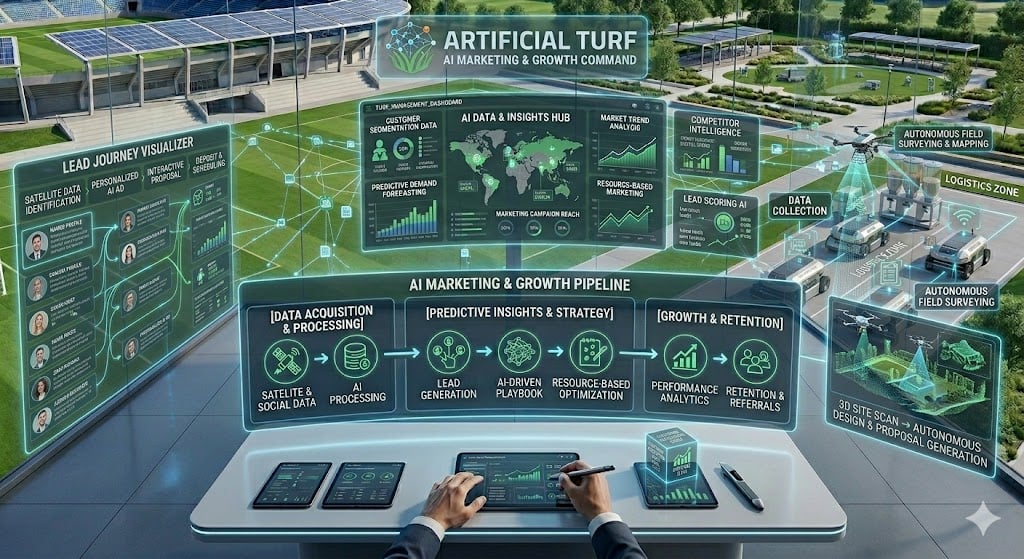
Artificial grass businesses are increasingly adopting artificial intelligence (AI) to refine their customer acquisition strategies. Competitive pressures demand more efficient lead generation and stronger customer engagement. By applying AI technologies, firms can streamline marketing operations, improve lead qualification, and support measurable growth. This article examines how AI reshapes lead generation for artificial grass installers, summarizes the primary benefits for customer acquisition, and identifies tools that support implementation.
Integrating AI into marketing addresses persistent operational issues such as delayed response times and inefficient lead handling. The following sections explain AI mechanisms for lead generation, outline the advantages, and provide practical implementation steps. We also identify the metrics turf companies should monitor to evaluate AI effectiveness.
How Does AI Transform Lead Generation for Artificial Grass Installation Companies?
AI enhances lead generation by applying predictive scoring and machine learning models to prioritise prospects. These systems analyse customer data to identify high-potential leads, enabling teams to focus on contacts with a greater probability of conversion. AI also automates qualification workflows, reducing time and resources spent on low-value leads.
Deploying AI-driven strategies improves marketing efficiency and strengthens customer engagement. The resulting operational streamlining contributes to higher conversion rates, positioning AI as a core component of contemporary marketing in the artificial grass sector.
What Are the Key Benefits of AI in Turf Business Customer Acquisition?
AI delivers multiple benefits for customer acquisition in the turf sector, including:
- Enhanced Lead Qualification: AI algorithms analyze customer behavior and preferences, enabling businesses to identify and prioritize leads that are more likely to convert.
- Faster Response Times: Automated systems can respond to customer inquiries in real-time, improving customer satisfaction and engagement.
- Improved Customer Engagement: AI tools can personalise marketing messages and offers based on customer data, leading to more effective communication and higher engagement rates.
Collectively, these capabilities can materially improve customer acquisition outcomes for artificial grass companies.
How Does Predictive Analytics Improve Lead Qualification in Turf Marketing?
Predictive analytics improves lead qualification by using data-driven scoring to estimate the likelihood of conversion. The process analyzes historical records and interaction data to detect patterns that indicate a lead’s potential value. Predictive scoring allows marketing teams to concentrate their efforts on prospects who demonstrate higher engagement.
Predictive analytics also supports immediate scheduling for high-probability leads, ensuring timely follow-up and improved conversion potential. This targeted method optimises media spend by allocating resources toward the most promising prospects.
Which AI Marketing Tools Are Most Effective for Artificial Grass and Landscaping Companies?
The following AI marketing tools are particularly relevant for artificial grass and landscaping firms:
- Artificial Grass Marketing (AGM): A specialized digital marketing platform focused exclusively on artificial grass and turf installation companies, offering tailored solutions for lead generation and customer engagement.
- HubSpot: A comprehensive marketing automation tool that integrates AI features for lead scoring and customer relationship management.
- Salesforce Einstein: An AI-powered tool that enhances customer insights and automates marketing processes, helping businesses to understand their customers better.
These platforms offer functionalities that can materially enhance marketing performance in the artificial grass sector.
What Features Define AI Platforms Tailored for Turf Installation Businesses?
AI platforms designed for turf installation commonly include features that support lead capture and qualification. Principal capabilities to evaluate include:
- Automated Customer Engagement: Tools that automate responses to customer inquiries and follow-ups, ensuring timely communication.
- Performance Measurement Tools: Analytics dashboards that track the effectiveness of marketing campaigns and lead conversion rates.
- Lead Generation and Qualification Features: Systems that utilize AI algorithms to score and prioritize leads based on their likelihood to convert.
Adoption of these features supports effective AI integration within marketing operations.
The emergence of specialized AI platforms underscores the industry’s shift toward advanced tools for operational improvement and efficient management.
AI-Driven Turf Management for Business Improvement
owners lack the right tools to track demand or improve their business. Organizers struggle to implement web-based turf-booking systems that integrate slot management, owner dashboards, and AI-driven features.
Next-Generation Turf Booking and Sports Management Using Modern Web Technologies, 2025
How Do AI Marketing Automation Tools Optimize Campaign Management?
AI marketing automation improves campaign management by refining targeting and automating responses to customer interactions. These systems segment audiences using customer data, enabling tailored messaging for defined groups.
AI-driven nurturing ensures prospects receive relevant information at appropriate stages, guiding them through the sales funnel. This automation reduces manual workload and increases the likelihood of conversion by maintaining consistent engagement.
What Are the Proven Results of AI Adoption in Artificial Grass Business Growth?
AI adoption in artificial grass firms has produced measurable outcomes, including:
- Accelerated Bookings: Companies using AI-driven lead-generation strategies have reported faster booking rates due to improved lead qualification.
- Increased Average Job Value: AI tools help businesses identify high-value projects, leading to higher average job values.
- Higher Conversion Rates: Businesses that implement AI technologies often experience significantly higher conversion rates compared to those relying on traditional methods.
These outcomes demonstrate AI’s effectiveness in supporting business growth within the artificial grass industry.
Which Case Studies Demonstrate Increased Lead Conversion Rates with AI?
Several case studies demonstrate AI’s impact on conversion rates. For example, one leading turf installation company reported a 30% increase in lead conversion within six months after deploying an AI-driven marketing platform.
Another case study described a landscaping business that applied predictive analytics to refine lead qualification, resulting in a notable reduction in customer acquisition costs. These examples illustrate tangible benefits to conversion performance and overall operational efficiency.
How Does AI Impact ROI and Cost Efficiency in Turf Marketing?
AI affects ROI and cost efficiency by automating processes that typically require substantial human effort. By shortening lead qualification and engagement cycles, businesses can allocate resources more efficiently and reduce operating costs.
AI-derived insights enable companies to optimise marketing strategies and allocate budgets toward higher-performing channels. This targeted allocation enhances marketing ROI and strengthens overall investment returns.
Research corroborates that AI can reduce customer acquisition costs while increasing conversion rates.
Optimizing Customer Acquisition Costs with AI Marketing
This research explores the innovative application of reinforcement learning (RL) and genetic algorithms (GA) to optimise customer acquisition cost (CAC) efficiency in AI-driven marketing strategies. By integrating RL and GA, the study aims to develop a hybrid model that autonomously adapts and evolves marketing tactics to reduce CAC while maintaining high conversion rates.
Enhancing Customer Acquisition Cost Efficiency through Reinforcement Learning and Genetic Algorithms in AI-driven Strategies, A Sharma, 2022
How Can Turf Businesses Implement AI Customer Acquisition Successfully?
To implement AI for customer acquisition, turf businesses should follow these steps:
- Utilizing AI-Powered Tools: Invest in AI marketing platforms that offer with features tailored to the needs of the turf industry.
- Automated Customer Engagement Strategies: Develop automated systems to respond to customer inquiries and nurture leads.
- Performance Measurement Frameworks: Establish metrics to evaluate the effectiveness of AI strategies and to make data-driven adjustments.
These steps offer a practical roadmap for integrating AI into customer acquisition processes.
What Are the Step-by-Step Processes for Integrating AI Marketing Solutions?
Integrating AI marketing solutions requires the following key steps:
- Assessing Current Processes: Evaluate existing marketing strategies to identify areas where AI can add value.
- Selecting Appropriate AI Tools: Choose AI platforms that align with business goals and customer needs.
- Training Staff on New Technologies: Ensure that team members are equipped with the knowledge and skills to utilize AI tools effectively.
Adhering to these steps enables turf businesses to deploy AI solutions that strengthen marketing performance.
Which Metrics Should Turf Companies Monitor to Measure AI Effectiveness?
Turf firms should monitor the following metrics to assess AI effectiveness:
- Lead Conversion Rate: The percentage of leads that convert into paying customers.
- Marketing ROI: The return on investment for marketing campaigns, indicating the effectiveness of spending.
- Customer Lifetime Value: The total revenue generated from a customer over their relationship with the business.
Regular tracking of these indicators yields actionable insight into AI-driven marketing performance.
What Are the Common Challenges and Solutions in AI Marketing for Artificial Grass Companies?
AI marketing presents benefits and operational challenges that turf companies must address. Common issues include:
- Data Quality Issues: Inaccurate or incomplete data can hinder the effectiveness of AI algorithms. Businesses should invest in data cleaning and management practices to ensure high-quality inputs.
- Resistance to Change: Employees may be hesitant to adopt new technologies. Providing training and demonstrating the benefits of AI can help overcome this resistance.
- Complex Integration Challenges: Integrating AI solutions with existing systems can be challenging. Companies should work with experienced vendors to ensure a smooth transition.
Proactive mitigation of these issues allows turf businesses to realise the full benefits of AI in their marketing programs.
How to Overcome Data Integration and User Adoption Barriers?
To address data integration and user adoption barriers, turf businesses can adopt these strategies:
- Investing in Training: Provide comprehensive training programs to help employees understand and utilise AI tools effectively.
- Fostering a Culture of Innovation: Encourage a mindset that embraces change and innovation throughout the organization.
- Starting with Pilot Projects: Implement AI solutions on a small scale before full deployment to identify potential issues and refine processes.
These measures facilitate smoother transitions to AI-driven marketing.
What Legal and Contractual Considerations Should Be Addressed?
When deploying AI solutions, turf businesses must address specific legal and contractual matters:
- Clarity in Contracts: Ensure that contracts with AI vendors clearly outline responsibilities, deliverables, and performance expectations.
- Protection Against Disputes: Establish mechanisms to resolve disputes that may arise during the implementation of AI solutions.
- Compliance with Laws: Stay informed about regulations governing data privacy and AI use to ensure compliance.
Proactive attention to these matters mitigates legal risk associated with AI adoption.
How Does Digital Marketing for Artificial Grass Businesses Leverage AI for Competitive Advantage?
Digital marketing leverages AI to improve lead qualification and automate customer engagement. AI tools analyse customer data to identify trends and preferences, enabling firms to tailor marketing strategies effectively.
AI-driven insights support data-informed decisions that optimise marketing activity. Strategic application of AI improves customer acquisition and strengthens competitive positioning.
What Strategies Enhance Customer Targeting and Lead Funnel Optimization?
To enhance customer targeting and optimise lead funnels, turf businesses should consider the following strategies:
- Adopting AI-Driven Tools: Utilize AI platforms that provide advanced targeting capabilities and insights.
- Personalized Marketing Strategies: Tailor marketing messages based on customer data to improve engagement.
- Lead Nurturing Automation: Implement automated systems to guide leads through the sales funnel with relevant information and offers.
These approaches substantially increase the effectiveness of targeting and lead management.
How Do AI Tools Support Smarter Customer Acquisition Compared to Traditional Methods?
AI supports smarter customer acquisition by improving lead qualification and reducing response times compared with manual methods. Automated lead scoring prioritises high-potential prospects, ensuring that marketing efforts target the most promising opportunities.
AI systems analyse large datasets to reveal trends and customer preferences, enabling precise strategy adjustments. This data-driven method increases efficiency and conversion rates.
For businesses seeking to enhance their customer acquisition strategies, Artificial Grass Marketing provides tailored solutions.
Frequently Asked Questions
What types of AI technologies are most beneficial for artificial grass businesses?
Artificial grass firms can apply several AI technologies: machine learning for predictive analytics, natural language processing for customer interactions, and automation for lead management. Machine learning identifies trends and informs marketing optimisation; natural language processing supports chatbots and automated responses. Together, these technologies streamline operations, improve customer experience, and support growth.
How can artificial grass companies measure the success of their AI initiatives?
Measure AI success by tracking key performance indicators such as lead conversion rate, customer engagement levels, and marketing ROI. Monitor customer lifetime value and the efficiency of lead-qualification processes for additional insights. Regular analysis enables data-driven adjustments to improve outcomes.
What role does customer feedback play in refining AI marketing strategies?
Customer feedback provides direct insight into preferences, pain points, and satisfaction levels. Incorporating feedback loops enables algorithms to be adjusted for better personalisation and engagement. This iterative process supports continuous improvement and keeps marketing aligned with customer needs.
Are there specific challenges in implementing AI for small artificial grass businesses?
Small firms may face limited budgets for technology, a lack of technical expertise, and resistance to organisational change. Data quality problems can also reduce AI effectiveness. To mitigate these challenges, start with pilot projects, invest in targeted training, and select affordable, industry-appropriate solutions to build capability incrementally.
How does AI enhance customer personalization in marketing for turf businesses?
AI enhances personalisation by analysing customer data to determine individual preferences and behaviours. Firms can then tailor messages, offers, and recommendations for defined segments. Automated delivery of personalised content at optimal times improves engagement, conversion, and customer retention.
What future AI Trends should artificial grass businesses be aware of?
Key trends to monitor include the broader use of advanced analytics for predictive modelling, the growth of voice-enabled customer interfaces, and the integration of AI with augmented reality to enhance customer demonstrations. Continued advances in automation and data-driven decision-making will further expand AI capabilities. Staying informed preserves competitive advantage.
How can turf businesses ensure compliance with data privacy regulations when using AI?
Ensure compliance by implementing robust data governance, obtaining explicit customer consent for data collection and usage, and documenting clear data protection policies. Regularly review adherence to applicable regulations, such as the GDPR or the CCPA. Provide staff training on data privacy practices and choose AI solutions with strong security controls.
Conclusion
Adopting AI for customer acquisition gives artificial grass businesses a competitive advantage by improving lead qualification and reducing response times. Advanced tools enable firms to streamline marketing, enhance engagement, and drive measurable growth. Insights derived from AI can optimise strategy and increase conversion rates. Discover how our tailored solutions can elevate your business today.