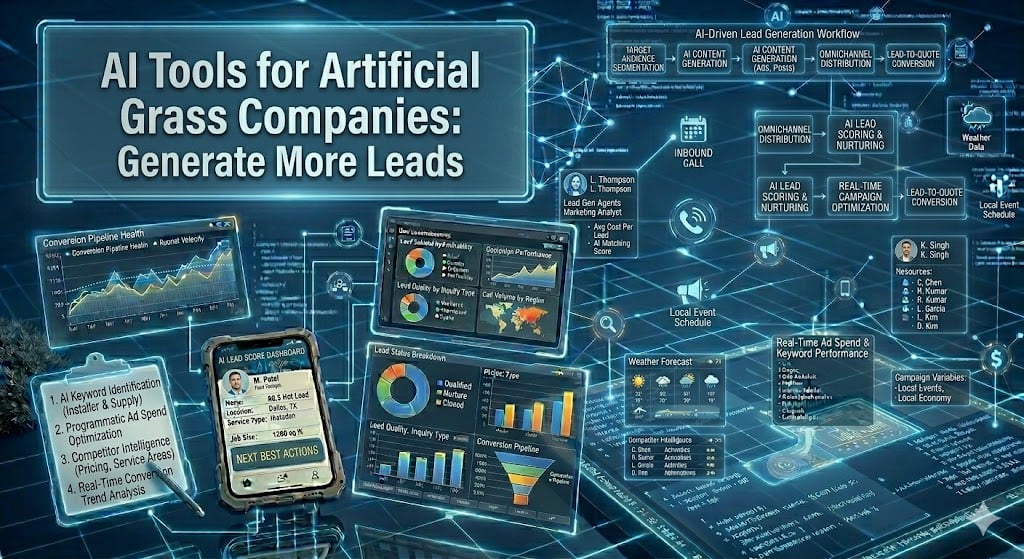
Competition in the artificial grass sector requires the adoption of advanced technology to generate leads and support business growth. AI tools enable companies to streamline marketing, improve lead capture, and nurture prospects more efficiently. This article examines how AI marketing automation enhances lead generation, outlines key features of AI marketing tools, and reviews CRM solutions suited to turf businesses. It also evaluates the role of predictive analytics and AI-driven lead capture in optimizing customer acquisition and conversion.
How Can AI Marketing Automation Enhance Lead Generation for Turf Companies?
AI marketing automation improves lead generation by automating processes and increasing operational efficiency. Artificial intelligence can identify high-quality prospects, automate qualification, and personalise outreach based on customer data and behaviour. As a result, turf firms can concentrate resources on leads with higher conversion rates and greater conversion probability, thereby increasing sales and revenue.
Recent research underscores AI’s role across lead management stages, from initial research through automated nurturing.
AI Marketing Automation for Lead Generation
Using artificial intelligence (AI) in lead management is increasingly important. The analysis covered lead research, lead generation, lead engagement, lead scoring, and lead automation. Based on the findings, a Lead Automation Maturity Index (LAMI) was calculated for each company, and actionable recommendations were provided.
Marketing Automation & AI Report 2024: tactics & tools of
AI-based lead generation, D Zumstein, 2024
Artificial Grass Marketing (AGM) provides a suite of AI tools to automate and optimize marketing campaigns, improve lead capture, and support prospect nurture through the sales funnel. These tools reduce manual effort and increase marketing effectiveness, making them valuable for artificial grass companies competing in the market.
What Are the Key Features of AI Marketing Tools for Artificial Grass Installers?
AI marketing tools for artificial grass installers include the following core features:
- Lead Generation and Qualification: AI tools can analyze data to identify potential leads and assess their likelihood of conversion, allowing businesses to prioritize their outreach efforts.
- Automated Customer Engagement: Through chatbots and automated email campaigns, companies can maintain consistent communication with leads, ensuring they receive timely information and support.
- Reputation Management: AI tools can monitor online reviews and social media mentions, helping businesses manage their reputation and respond to customer feedback promptly.
Together, these capabilities enable artificial grass companies to optimize marketing performance and raise lead conversion rates.
| Feature | Description | Benefit |
|---|---|---|
| Lead Generation | Identifies potential leads through data analysis | Increases efficiency in targeting prospects |
| Automated Engagement | Uses chatbots for real-time customer interaction | Enhances customer experience and satisfaction |
| Reputation Management | Monitors online presence and feedback | Protects brand image and fosters trust |
The table demonstrates how AI marketing tools can materially improve operational efficiency for turf businesses.
How Does Marketing Automation Improve Turf Business Sales Funnels?
Marketing automation strengthens sales funnels by automating lead qualification and nurturing. By removing repetitive tasks, teams can engage leads more promptly, improving response times and customer interactions that support conversion.
Automation also enables personalised communication derived from customer behaviour and preferences. This targeted approach increases the probability of conversion and supports long-term client relationships, driving repeat business and referrals.
Which CRM Solutions Are Best Suited for Artificial Grass Installation Companies?
Selecting an appropriate CRM is essential for artificial grass installers. Notable options tailored to the sector include:
- Artificial Grass Marketing (AGM): Known for its comprehensive features tailored to turf professionals, AGM offers tools for lead management, customer engagement, and marketing automation.
- Salesforce: A widely recognized CRM platform that provides extensive customization options and integration capabilities, making it suitable for businesses of all sizes.
- HubSpot: Offers a user-friendly interface and a range of marketing tools, including email marketing and social media management, ideal for small to medium-sized turf companies.
Each of these platforms delivers capabilities that support lead management and strengthen customer interaction, contributing to measurable business growth.
What CRM Features Support Lead Management in Turf Businesses?
Several CRM features are central to effective lead management:
- Lead Tracking: Enables businesses to monitor lead status throughout the sales funnel, ensuring timely follow-ups and engagement.
- Lead Nurturing: Automated workflows can be set up to nurture leads through personalized communication, increasing the likelihood of conversion.
- Sales Pipeline Management: Provides a visual representation of the sales process, helping teams identify bottlenecks and optimize their strategies.
Implementing these features helps turf firms manage leads systematically and reduces the risk of losing potential customers.
How Does CRM Integration Boost Customer Retention for Artificial Turf Installers?
CRM integration centralises customer data, enabling consistent communication and tailored service. Better tracking of interactions, preferences, and purchase history allows companies to adjust service delivery to individual customers.
Research further indicates that data and AI integration can transform service operations, improving resource allocation and customer retention.
AI & Data Integration for Lawn Care Services
This article examines the impact of digital technologies, artificial intelligence, and data integration on lawn care service operations. It considers how weather-dependent service industries can use master data management, weather integration components, and AI-driven analytics to optimise resource allocation, improve customer retention, and enhance service delivery.
Leveraging Data Integration and AI for Intelligent Lawn Care Service Operations, SP Singh, 2025
CRM systems also enable proactive customer engagement, such as maintenance reminders and follow-up offers. These actions foster loyalty and encourage repeat business, which is critical for long-term success in the artificial grass sector.
What Are the Most Effective Lead Generation Software Options for Turf Companies?
Several software solutions are effective for turf lead generation:
- Artificial Grass Marketing (AGM): An all-in-one platform that offers AI-powered tools for automated marketing campaigns and lead capture.
- Leadfeeder: This software identifies website visitors and provides insights into their behavior, helping businesses target potential leads more effectively.
- OptinMonster: A powerful lead generation tool that allows companies to create engaging opt-in forms and pop-ups to capture visitor information.
These platforms provide the tools required to capture and nurture leads more efficiently.
How Do AI-Powered Lead Capture Tools Increase Qualified Leads?
AI lead-capture tools improve lead quality by automating qualification. They analyse website visitor behaviour to identify prospects based on interaction and engagement. Focusing on higher-quality leads enables turf companies to allocate resources more effectively and increase conversion rates.
These tools integrate with CRM systems to ensure qualified leads are transferred into the sales pipeline for ongoing nurturing. This integration streamlines lead management and raises operational efficiency.
What Role Does Predictive Analytics Play in Turf Business Lead Conversion?
Predictive analytics improves conversion by analysing historical data and customer behaviour to estimate conversion probability and surface the most promising leads. Companies can prioritise outreach and tailor marketing strategies based on these forecasts.
Predictive models also inform media allocation by identifying channels with the highest return on investment. This data-driven approach enables informed decisions that improve marketing effectiveness and support revenue growth.
How Can Artificial Turf Sales Funnel Software Optimize Customer Acquisition?
Sales funnel software designed for artificial turf firms clarifies the customer acquisition process. Visualising the sales journey helps identify areas for improvement and refine the strategy.
These systems can automate stages from lead capture to follow-up, ensuring prospects receive timely information and support, thereby increasing the likelihood of conversion.
What Are the Stages of a Digital Sales Funnel for Artificial Grass Companies?
Understanding the stages of the digital sales funnel is essential for optimising customer acquisition.
- Discovery: Potential customers become aware of the brand and its offerings through marketing efforts.
- Interest: Customers express interest in products or services, often by visiting the website or engaging with content.
- Evaluation: Customers compare options and assess the value of the offerings before deciding.
Effective management of each stage improves conversion rates and supports business growth.
How Does AI Enhance Lead Nurturing and Conversion Optimization?
AI improves lead nurturing and conversion by automating personalised communication and engagement. Machine learning analyses customer behaviour and preferences to enable targeted messaging.
Personalisation increases the likelihood of conversion because communications align with customer needs. AI continuously refines strategies using real-time data so turf companies maintain competitive marketing.
What Case Studies Demonstrate Success Using AI Tools in Turf Marketing?
Case studies demonstrate measurable results from AI integration in turf marketing. For example, a leading artificial grass company implemented AI-driven marketing automation and achieved a notable increase in lead conversion within six months by using predictive analytics to identify high-value leads and tailoring outreach accordingly.
Another study reported that AI chatbots improved engagement and reduced response times, which led to higher customer satisfaction and increased sales. These outcomes illustrate the practical benefits of AI tools in marketing.
Which Metrics Show Lead Growth and Conversion Improvements?
Turf companies should monitor several key metrics to evaluate lead generation effectiveness:
- Cost-per-Lead (CPL): This metric represents the cost associated with acquiring a new lead, helping businesses assess the efficiency of their marketing strategies.
- Lead-to-Sale Conversion Rate: This percentage reflects the effectiveness of the sales process in converting leads into paying customers.
- Customer Lifetime Value (CLTV): Understanding the long-term value of customers helps businesses make informed decisions about marketing investments.
Tracking these indicators provides actionable insights into lead generation and conversion performance, enabling continuous optimisation.
How Have Turf Businesses Benefited from AI Marketing Automation?
Turf businesses report benefits from AI marketing automation, including better lead qualification, faster response, and improved customer engagement. Automation frees staff to focus on relationship-building and personalised service.
AI-driven automation supports data-based decision-making, allowing firms to optimise marketing strategies using real-time insights. This responsiveness is essential in a competitive market.
What Future Trends in AI Will Impact Lead Generation for Artificial Grass Companies?
Future AI trends affecting lead generation include advances in natural language processing (NLP) that will improve chatbot and virtual assistant interactions, as well as increased hyper-personalisation to tailor marketing at the individual level.
Data privacy regulations will influence how companies deploy AI, requiring transparent practices as they leverage AI for lead generation. Staying current on regulatory developments is necessary for compliance and competitive positioning.
How Will AI Chatbots and Predictive Analytics Evolve in Turf Marketing?
AI chatbots will handle more complex inquiries and provide personalised recommendations based on user behaviour, enhancing customer experience and streamlining sales.
Predictive analytics will offer more accurate forecasts of trends and customer preferences, enabling proactive marketing adjustments to maintain relevance and effectiveness.
What Emerging AI Technologies Should Turf Businesses Monitor?
Turf firms should monitor the following emerging AI technologies:
- Natural Language Processing (NLP): Enhances customer interactions through improved understanding of language and context.
- Image Recognition: Can be used for visual marketing strategies, allowing businesses to analyze customer preferences based on visual content.
- Machine Learning: Continues to improve predictive analytics and customer insights, enabling more effective marketing strategies.
Monitoring these developments will help turf companies capitalise on new opportunities for growth and lead generation.
Frequently Asked Questions
What are the benefits of using AI tools for lead generation in the artificial grass industry?
AI tools increase efficiency in identifying high-quality leads and automate qualification. By analysing customer data and behaviour, these tools enable precise targeting and personalised communications, improving conversion rates and driving sales growth.
How can turf companies measure the success of their AI marketing strategies?
Measure AI strategy success using KPIs such as lead conversion rate, engagement metrics, and return on investment (ROI). Metrics like cost-per-lead (CPL) and customer lifetime value (CLTV) quantify efficiency. Combine quantitative measures with customer feedback to guide strategy adjustments.
What role does customer feedback play in optimizing AI marketing tools?
Customer feedback informs the optimisation of AI tools by revealing users’ experiences and preferences. Incorporating feedback improves targeting and personalisation; feeding insights into AI models enhances engagement and conversion.
How can turf companies ensure data privacy while using AI tools?
Ensure data privacy by implementing transparent data practices and complying with applicable laws, such as the GDPR or the CCPA. Obtain explicit consent before collecting personal data, document how data will be used, and apply security measures such as encryption and access controls. Conduct regular audits and update privacy policies to maintain compliance and customer trust.
What are some common challenges turf companies face when implementing AI marketing tools?
Common challenges include limited technical expertise, staff resistance to change, and integration issues with existing systems. Data quality and availability can also constrain AI effectiveness. Mitigate these issues through training, phased implementation, and robust data governance.
How can turf companies leverage social media in conjunction with AI tools?
Combine AI analytics with social media to understand audience behaviour and refine content and ad targeting. Use AI to automate routine social interactions and schedule posts, maintaining consistent engagement and driving website traffic to increase lead generation.
Conclusion
Adopting AI tools for lead generation yields measurable advantages, including improved identification of high-quality leads and automated qualification. These technologies enable personalised marketing, stronger customer engagement, and higher conversion rates. By adopting AI-driven strategies, turf companies can position themselves for sustained growth in competitive markets. Discover how our AI solutions can transform your lead generation efforts today.